Join a community of readers who are committed to Jewish stories
Sign up for JBC’s Nu Reads, a curated selection of Jewish books delivered straight to your door!
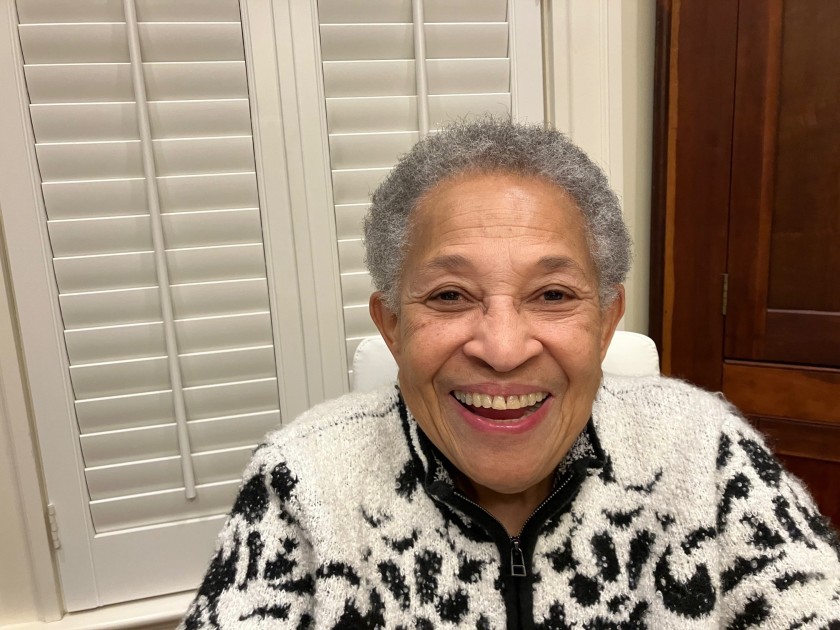
Author phot of Carol Conaway, courtesy of the publisher
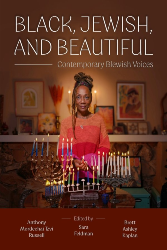
What follows is a portion of the chapter “Judaism Redux” by Carol Conaway from Black, Jewish, and Beautiful: Contemporary Blewish Voices, an anthology edited by Anthony Mordechai Tzvi Russell, Sara Feldman, and Brett Ashley Kaplan.
The day I turned twenty-one, I called a number I’d been given by a Jewish friend about classes for conversion for those who were about to marry non-Jews. I called the office and told the receptionist I wished to enroll and convert. My application was accepted, although I left blank the spaces about when the wedding was and whom I was marrying.
When I arrived at my first class in October 1970, I sat down at a classroom in Temple Beth Zion, a Conservative synagogue in Center City Philadelphia. I quickly deduced that I was the only student in the class of seventeen who wasn’t there because of an impending marriage. However, by this time I was used to being “the only one” because that was the way I had been with the Barskys.
Our teacher appeared. He introduced himself as Rabbi Goodman, then turned to his secretary, who was seated in the front of the classroom, and asked for the list of students. He then called roll. When I raised my hand to announce that I was present, he gave me a rather quizzical look but continued with the class as he had planned.
The closer it came to my “official” conversion, I began to lose my nerve. Rabbi Goodman had stressed that when the non-Jewish classmates converted, our lives would change drastically. First, as Jews we would have to keep kosher for the rest of our lives. Second, we would have to part company with our birth families. I had long since defied my parents by being secretly Jewish, studying every book about all things Jewish that I could get my hands on, learning more Hebrew, and forming a deep attachment to Israel — in part because my dear friend Chana Rosenbaum (née Anne Barsky) now lived in Bet El, one of the pioneering settlements on the West Bank; in part because I knew that if another Hitler arose to power, the only place I would be safe was Israel; and in part because I loved God and was proud to become a member of “the Chosen People.” I knew very little about my Black heritage because I had never been exposed to any Black history. I knew far more about Jews than I knew about Black people or Christianity. In fact, I knew more about Judaism than anyone in my class and anyone in my social circle except Chana.
I missed a couple of classes on purpose. Then one afternoon I received a call from Rabbi Goodman’s secretary, telling me that he wanted me to finish the classes now that we were just a couple of weeks before the end. I told her that I would come back to the rabbi’s classes. I made that assertion quite confidently because I interpreted her phone call as expressing the rabbi’s hope that I would be successful in converting. I had never spoken with him about my fierce attachment to Judaism and life as a Jew, and he had never asked me any questions. I suppose he believed that I was sincere and felt concerned because he knew that I would be alone. He had no idea that I was a lesbian and suffered from severe depression. He accepted me based on my responses in class and my obvious sincerity.
Finally, it came time for me to appear, with Rabbi Goodman, before a bet din comprising three rabbis. The three rabbis looked very stern as I took my seat before them. Once the questioning began, I noticed that the questions were becoming more and more difficult to answer. One question I clearly remember was posed by the rabbi who sat in the middle of the other two. He asked me how I would know if my plane crashed and that I had parachuted to a Jewish town. At that point, Rabbi Goodman jumped up and complained that the rabbi’s question was unfair and that the bet din had asked these very difficult questions only in my case. The rabbi who had asked the question said, “Either she can answer my question or not.”
At that point, Rabbi Goodman returned to his seat, and I began responding. I stated that I would see mezuzahs on the right-hand doorposts of the houses; that if it were Shabbat, I would see women blessing lit candles and men sipping wine from a beautiful cup and the family chanting after dinner; that there would be a synagogue and that families would go to services on Shabbat morning; and that the men would be wearing tallises.
The questioning rabbi interrupted me at that point and asked me, “Don’t you have enough problems being Black? Why add to those by becoming a Jew?”
To that, I responded that I already was a Jew and that I understood that this was a requirement for my formal conversion. At which point, the questioner shook his head and dismissed the court. Rabbi Goodman told me that he was proud of me.
A week later, the classmates of mine who hadn’t dropped out of conversion class and I went to a synagogue in Elkins Park (another Philadelphia suburb), Temple Beth Shalom, which was a social center in addition to being a temple. It contained a large swimming pool. Rabbi Goodman said the pool would be our mikveh. We women were told to change into our bathing suits and return to the mikveh.Then the men went to a circumcision ceremony in another part of the synagogue. When they returned to the pool, we all participated in our first mitzvah — that is, the ritual of bathing in the mikveh and renouncing all other religions to become Jews. Finally, I had kept my promise to myself to let nothing stand in the way of my becoming a Jew. The plight of the Jewish people would be mine — even if that meant I had to die.
Once we left the mikveh and dressed in our street clothes, all of us moved to the main sanctuary of the temple. To my utter relief, there sat four of the five Barskys: Naomi (whose name I had chosen as my Hebrew name because in my estimation she was the ideal Jewish woman — the woman I hoped to be), Jay, Deborah, and Dan. Then Rabbi Goodman gave a very brief speech about the new Jews and began reading the list of my classmates.
The first name he called was mine. I rose and walked to the bimah. Once I reached him, Rabbi Goodman gave me a paper written in Hebrew and English and told me that it was my proof that I was a Jew and to use it for identification when asked for it. Then he shook my hand, and I returned to my seat, where I’d been with a handful of friends my age. When I looked at “my family,” I saw that Naomi was beaming. Once again, my Jewish family, the Barskys, were there for me. They had never questioned me about who I was and why I had chosen Judaism. Instead, they took it upon themselves to help shape my life as a Jew.