Join a community of readers who are committed to Jewish stories
Sign up for JBC’s Nu Reads, a curated selection of Jewish books delivered straight to your door!
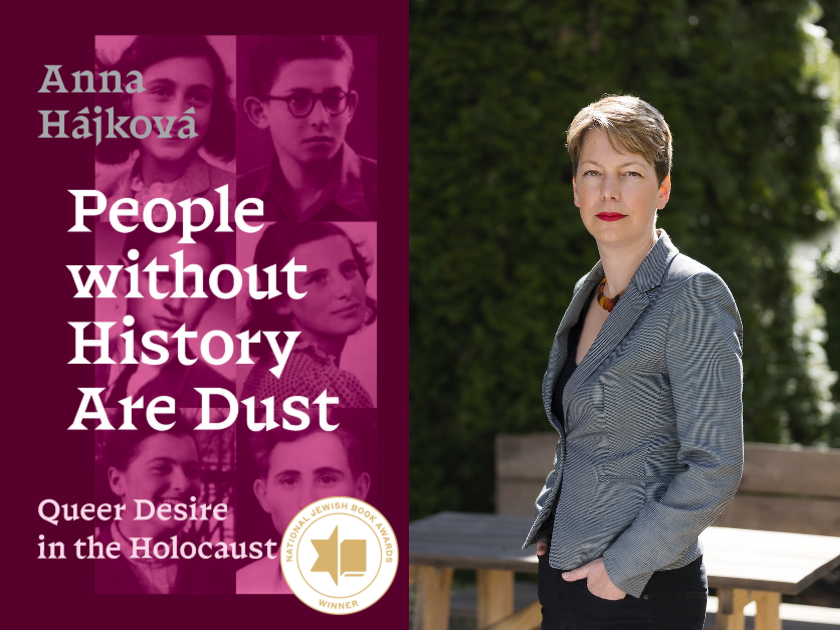
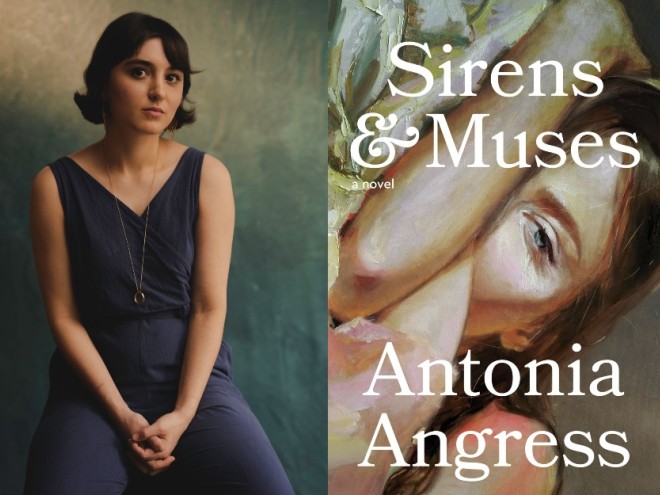
Author photo by Václav Jirásek
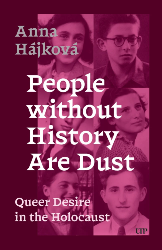
Anna Hájková’s People Without History Are Dust: Queer Desire in the Holocaust won the 75th National Jewish Book Award in the Holocaust category for the groundbreaking lens through which it analyses the Holocaust. Hájková explores how homophobia informed not only Nazi ideology, but also queer survivors and even those who recorded their testimonies — ultimately leading us to believe in a much simpler version of the Holocaust than the deeply nuanced reality. Hájková’s mission is “to make the history of this genocide more inclusive,” and to return queer people who lived and died during the Holocaust “to their place in history.” In the following conversation, she discusses concentration camp hierarchy, why we overlook the queer desire Anne Frank expressed in her diary, and what we should all know about Irene Miller, an oft-forgotten figure who “was deliberately both a butch and a survivor.”
Becca Kantor: Reading your book, I was struck by how fundamentally homophobia has impacted our perception of the Holocaust. Not only have Holocaust survivors been reluctant to speak about queer experiences, but also researchers have gathered testimonies in ways that overlook their subjects’ queer identity or implicitly condone homophobia. Are there instances of this that stood out in particular to you?
Anna Hájková: It is really quite shocking how prevalent homophobia was among concentration camp inmates. That prejudice was not a continuation of interwar homophobia, but rather a societal reaction to imprisonment. By marking some behavior as monstrous, homophobia allowed prisoners to make sense of the horror and violence surrounding them. This homophobia then influenced the perception of pretty much all queer sexuality in the camps. Given that, it became very hard for queer Jewish survivors to speak of their experiences: bearing testimony is shaped by social norms.
What is remarkable is that this homophobia even imprinted on younger scholars. In the Shoah Foundation, you find a number of interviewers asking, apropos of nothing, questions like, “Did you meet any evil lesbian kapos?” Imagine how hard it would be to say: “In fact, I met my partner in the camps — but she is evil only when she does not get lunch on time!”
BK: I was also surprised to learn that Anne Frank openly expressed queer desire in her diary — which might seem strange, given that I’ve read the diary! But you point out that the passages in which Anne expresses her attraction to women, particularly her close friend Jacqueline van Maarsen, have slipped past many other readers, too. Why is this aspect of Anne Frank’s life not widely recognized?
AH: Women have it much harder than men to be seen as legitimate witnesses: the “key” Holocaust testimonies are by Primo Levi or Elie Wiesel, not Liana Millu. Anne Frank can be counted alongside the iconic male voices because she was a child, not a woman. As Cheryl Hann pointed out, being recognized for her queerness would strip her of her epistemic legitimacy. And so we read those passages in her diary where she talks about her attraction to women, but they do not register.
By the way, I have approached several Anne Frank institutions and suggested working together. After all, they are keen to reach out to young audiences, and young people are particularly interested in inclusion and diversity, and what exemplifies this more than queer history? But none of these institutions have expressed interest.
You find a number of questions like, ‘Did you meet any evil lesbian kapos?’ Imagine how hard it would be to say: ‘In fact, I met my partner in the camps — but she is evil only when she does not get lunch on time!’
BK: By bringing queer Holocaust stories to light, you expose the fallacy of placing victims in mutually exclusive categories — assuming that someone was either Jewish or queer, a victim or a perpetrator. Do you think this has affected how your work has been received? Why do both survivors and society at large struggle to accept these nuances?
AH: Becca, I would be curious to hear your take on that question! I wrote a book of historical research on Jewish Holocaust victims and survivors whom the Nazis persecuted as Jews, who survived in camps, ghettos, and in hiding, and who engaged in same sex desire. Queerness was part of their experience, and something they could not talk about due to the survivor homophobia. I’m returning them to their place in history. This doesn’t take anyone’s place away, but it shows how to make the history of this genocide more inclusive. Who would not be on board for that?
BK: You take great care in how you label your subjects’ sexuality and gender. For example, in writing about the female impersonator Hambo, you explain that you refer to Hambo as “they” not because you’re assuming that this is how they would refer to themself, but in order to “leave space for not knowing.” In your discussion of Anne Frank’s diary, you caution readers not to retroactively label Frank’s sexuality. Why are these considerations so important when discussing figures from the past?
AH: I am a historian, and therefore I need to historicize — that is, to explain how things were understood in the past as opposed to how we see them now. Today, we operate with hard sexual identities. But in the 1940s, in many countries, that was not a thing. And even when they were aware of what they would have called “homosexuality” (say in Germany or Poland), many of my subjects did not engage in same-sex relationships after the war. To call them gay or lesbian or bisexual would be sticking them into reductive categories. “Queer” is an umbrella description, it includes both sexual self-definition and what people did and felt. So we cannot say that Anne Frank was “bisexual,” but she is part of queer history.
We cannot say that Anne Frank was ‘bisexual,’ but she is part of queer history.
BK: Could you name one historical figure in your book that you wish more people knew of? Why would you choose that person?
AH: Irene Miller! She was a Prague “half-Jewish” lesbian resistance fighter. Irene was arrested by the Gestapo and sent to Ravensbrück. After the war, when she saw most of her lesbian friends give in to societal pressures and marry, she settled down with a male fellow survivor. The marriage fell apart a few years later, and Irene ended up as a single parent in Paris. She moved to San Francisco and was part of the pre-Stonewall queer scene here. She also struggled with her trauma from the camps. Irene was deliberately both a butch and a survivor, and stood by all her identities. I was able to research her story thanks to the immense generosity of colleagues and Irene’s daughter, and that is a lasting gift.
Becca Kantor is the editorial director of Jewish Book Council and its annual print literary journal, Paper Brigade. She received a BA in English from the University of Pennsylvania and an MA in creative writing from the University of East Anglia. Becca was awarded a Fulbright fellowship to spend a year in Estonia writing and studying the country’s Jewish history. She lives in Brooklyn.