Join a community of readers who are committed to Jewish stories
Sign up for JBC’s Nu Reads, a curated selection of Jewish books delivered straight to your door!
This piece is part of our Witnessing series, which shares pieces from Israeli authors and authors in Israel, as well as the experiences of Jewish writers around the globe in the aftermath of October 7th.
It is critical to understand history not just through the books that will be written later, but also through the first-hand testimonies and real-time accounting of events as they occur. At Jewish Book Council, we understand the value of these written testimonials and of sharing these individual experiences. It’s more important now than ever to give space to these voices and narratives.
Two weeks before PJ Library’s Sephardic Stories Initiative retreat in March of 2026, I told the other writers in the group that I probably wouldn’t get to meet them in Pennsylvania. As an Israeli, I sensed that round two with Iran was imminent. Growing up with wars, you learn how to smell them; there is a subtle change of tone in the news. It’s like reading tea leaves, but instead of leaves, you learn to read armies, politicians, and social media buzz.
A month before the war began, I heard a story about a young man who travelled from Istanbul to Greece right before WWII. People asked him, “What are you doing here? War is coming.” The man replied, “Everything will be all right.” It wasn’t, of course, but for me optimism is the essence of Judaism. I embraced this optimism, reminding myself of a mantra I adopted when I was a kid: Relax, things can always get worse.
In 1991, I was nine years old and living in Ramat Gan, one of the most likelyspotsfor Scud missiles to hit. It may sound bizarre, but I have only good memories of my childhood, even during this war: I remember family humor, classroom meetings in apartments, and decorating my gas mask box.
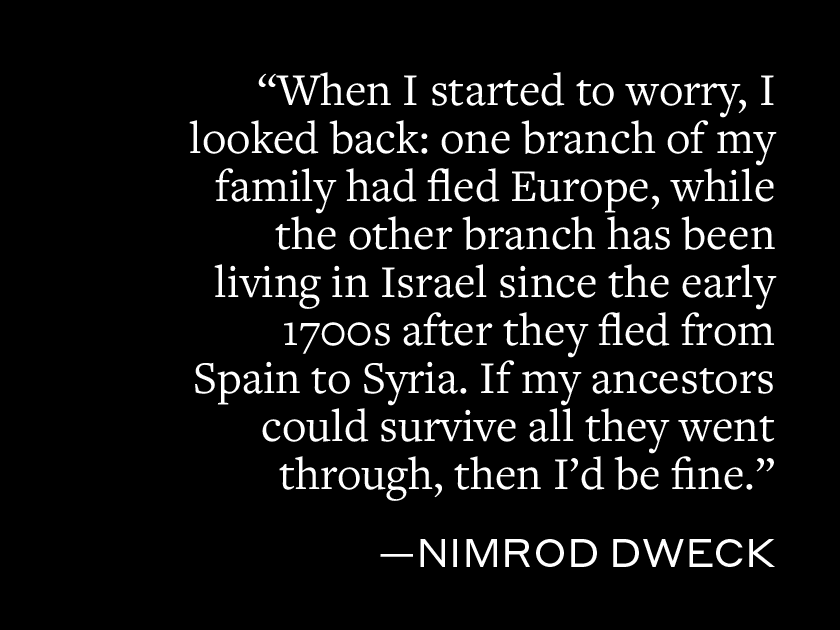
Now it is 2026, and I’m a grown man — a dad, a husband. When the war erupted, I tried to remain calm, playing the role expected of me. When I started to worry, I looked back: one branch of my family had fled Europe, while the other branch has been living in Israel since the early 1700s after they fled from Spain to Syria. If my ancestors could survive all they went through, then I’d be fine. Still, grim thoughts crawled in occasionally. Images of hundreds of missiles at once, destroyed buildings, and innumerable casualties clouded my mind. Fortunately, there was no substantial damage to the region where I live. So I relaxed, and things got worse.
But even in times of crisis, there is always work to do. Yalla, mister, get to business.
First, make sure the shelter is nice. Vacuum the life out of it. Add enough toys, arts and crafts materials, comfy pillows, blankets, and books.Second, internalize that there will be no kindergarten for the upcoming weeks. Create a new routine. Last, prepare the children for the sirens. Don’t freak out, kids. Walk casually to the shelter, sit in your corner, be kind to our neighbors.
This routine was punctuated by sirens, missiles, war talk. Quickly, I realized that you can’t hide war from kids, so the goal is to keep them occupied and find ways to still have fun. If they remember this period positively — the way I remember the Gulf War in the nineties — that’s an epic win.
This time in the shelter reminded me of my ancestors’ plight, which in turn connected me even more to the themes of the Sephardic Stories Initiative. Being of mixed heritage — my father Sephardic, my mother Ashkenazi— I often felt like I wasn’t enough of anything to claim either side of my roots; like I was caught between identities, but never fully entitled to either. As an adult, I was surprised how often conversations about business or politics opened with questions about my heritage. And always, I don’t meet the expectations that people have about either of these identities; for example,my last name doesn’t sound Mizrahi or Ashkenazi enough.
But since becoming a member of PJ Library’s Sephardic Stories Initiative in 2025, I’ve finally found a haven and a conduit through which I can explore my identity. During monthly virtual sessions with twelve other writers from around the world, I find myself considering — and drawing inspiration from — my family’s past in a way that is inherently joyful and creatively fulfilling. In the cohort, I’m accepted as I am. I enjoy hearing fellow writers in my cohort talk about their experiences; we learn from each other and get to know one another as friends. For someone who has invested in the lonely art of writing, it means the world.
And so I was deeply disappointed not to be able to attend the retreat in person in March of this year. Generously, an effort was made to help me and a fellow Israeli author experience the retreat virtually. We attended nearly every meeting — some of the highlights were a conversation with an agent, a breakdown of the hero’s journey for children’s books, a session on plot structure, and even one-to-one peer-reviews. Due to the time difference, I guessed that I wouldn’t be able to attend some of the meetings. Surprise again: I woke up at one in the morning to a siren blaring, grabbed the girls, and ran to the shelter. Fifteen minutes later, instead of going back to sleep, I joined another Zoom event. It was a moment to remind myself, even in the middle of the mayhem, that life offers much more than fear and violence; there is also a calling, and my craft is part of that.
I write primarily for children because I believe that it reminds us all that there is still good in this world. This art form serves as a beacon of hope. When I’m lost or heavy-hearted, children are a compass to navigate toward a better future. Writing for them is an inspiration.
A retreat is supposed to provide a safe, quiet space to write. During this one there were sirens, a rocket that landed at the end of my street, and conversations about human nature I never imagined having with my far-too-young daughters. Yet the retreat demanded that I write, and with every sentence, I found the strength to embrace the optimism that led my family to the Middle East generations ago. It created an imaginative hopeful space, even amidst war — a place where children played, a father wrote, and stories were told so we could remember the things that war tries to obscure. In doing so, the retreat offered more hope than I could have asked for.
The views and opinions expressed above are those of the author, based on their observations and experiences.
Support the work of Jewish Book Council and become a member today.
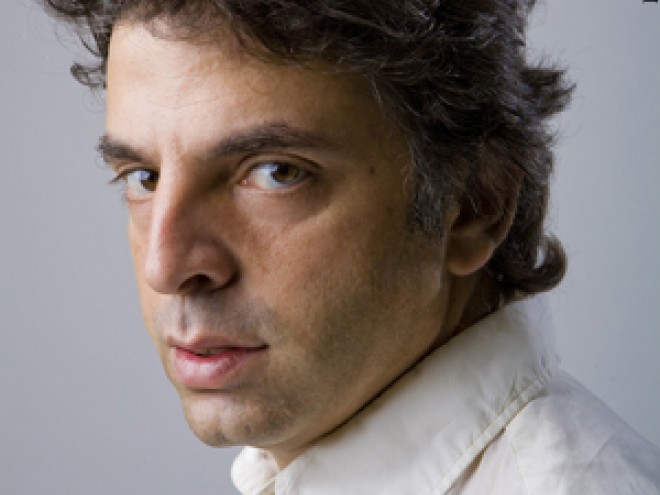
Nimrod Dweck is a game designer, speculative writer, and poet working across fantasy, science fiction, poetry, and comics. He has published poetry, a young adult novel, and is currently working on his second novel as well as children’s books. He is married, a father of two, and lives in Israel.