Join a community of readers who are committed to Jewish stories
Sign up for JBC’s Nu Reads, a curated selection of Jewish books delivered straight to your door!
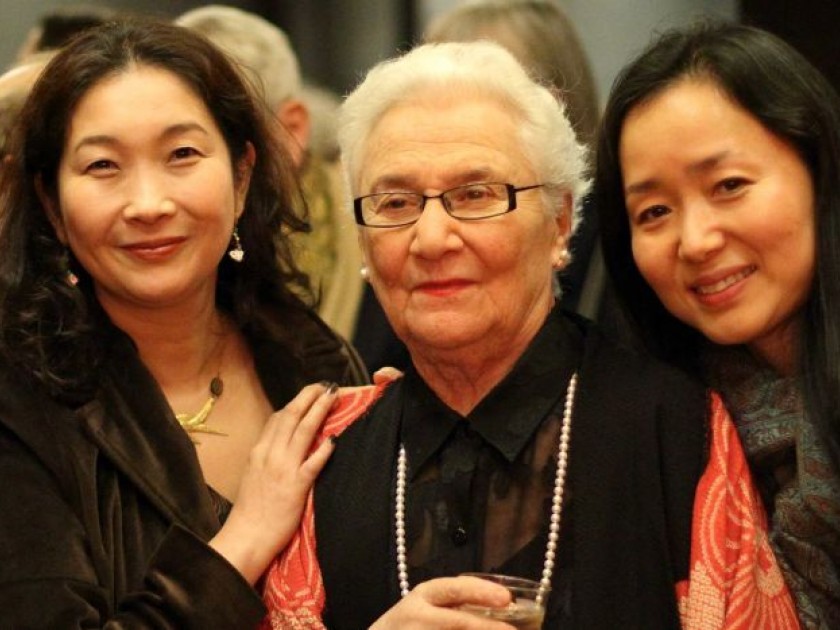
Beate, photo credit to ABC, from the University of Michigan website
I read everything. I mean, everything. It’s how I find the next book idea.
It’s how I came to read this obituary in the New York Times on January 2, 2013, with a growing mix of excitement, disappointment, and awe.
How had I never heard of the obit’s subject, Beate Sirota Gordon? How was I unaware of this Jewish woman born in Vienna, who had moved to Japan at age five, spoke perfect Japanese, and had been responsible, at the age of twenty-two, for both women’s rights clauses in the post-World War II Japanese Constitution?
I did, however, learn about Beate’s (pronounced Bay-AH-tay) incredible life. She was the daughter of the celebrated Russian-Jewish pianist Leo Sirota (whose recordings can still be heard on Youtube).
Leo came to Vienna, Austria, around the time of the 1904 pogroms in Ukraine, and married Augustine Horenstein, brother to the great conductor Jascha Horenstein. Beate was born in 1923.
In 1929, just before the Depression struck, Leo brought the family to Japan to teach and concertize. It was to be a few months; it ended up being years. While they were in Tokyo, the Nazis rose in Germany and Austria. The family was rendered stateless in the Anschluss. The Sirota family was fortunate to make it to Japan, as extended family members were lost in the Holocaust.
The family was rendered stateless in the Anschluss. The Sirota family was fortunate to make it to Japan, as extended family members were lost in the Holocaust.
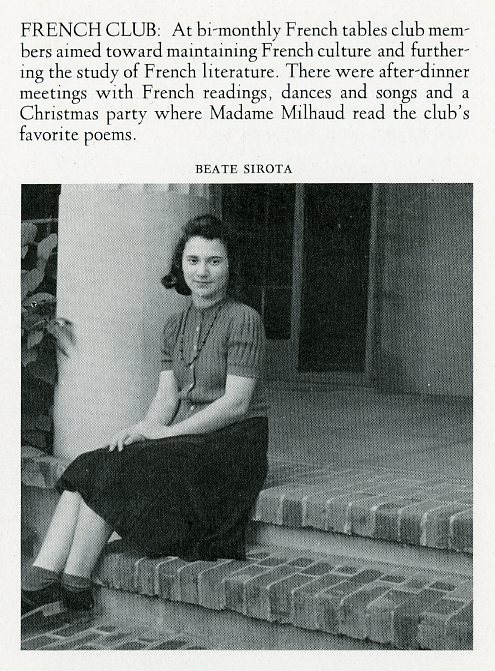
Beate at Mills College, 1942
Young Beate took to Japan with a keen mind, open heart, and innate gift for languages. She made Japanese friends, learned to speak idiomatic Japanese (plus English, French, and later, Spanish) to go with her Russian and German, and loved the country and its people. What she didn’t love was the deep misogyny around her, reflected in proverbs:
Women are devilish.
In women’s hearts dwell serpents.
There are no wise women.
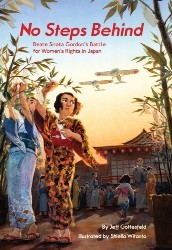
The title of my book, No Steps Behind, was inspired by one of these proverbs, “Women walk three steps behind.” As I write about Japan at the time, “There was a small movement for women’s rights, but men still controlled everything. Fathers could sell daughters to strangers… At many gatherings, women had no place at the table.” While there was indeed intense economic stress amongst much of the rural populace, fathers were not selling their sons.
Beate’s story is filled with the political and historical upheaval of the time in which she lived: off to Mills College at age fifteen because a return to Europe was out the question and few women were allowed in Japanese universities; cut off from parents by Pearl Harbor; supporting herself through her collegiate experience as a teenage War Department radio operator because America had put nearly all its Japanese speakers in internment camps; ultimately not knowing if her parents were alive or dead in the 1945 Tokyo firebombing. Then, on Christmas Eve, 1945 at age twenty-two, Beate returned to Japan as a cultural specialist and interpreter for the occupying American forces. She was able to find her parents alive, and began an assignment with General MacArthur’s team creating a new postwar Constitution.
She drafted and advocated for Articles Fourteen and Twenty-Four, the equal rights for women clauses — over the skepticism of her superior officers, and to the ire of the all-male Japanese negotiators
Conscious of her unique chance to speak up for the Japanese women she knew and loved, who were not allowed to speak for themselves, she drafted and advocated for Articles Fourteen and Twenty-Four, the equal rights for women clauses — over the skepticism of her superior officers, and to the ire of the all-male Japanese negotiators. But when the outraged parties were informed that the female translator they appreciated so much, and who knew their country so well, had authored these clauses challenging the status quo, they went ahead and approved them.
But wait, there’s more.
Both the United States and Japan rendered the details of the negotiations a state secret for decades, and Beate never said a word. Instead, she became a cultural programmer for the Japan Society and Asia Society in New York City, devoting her professional life to forging a cultural reconciliation between two formerly bitter enemies.
When the story finally broke in the late 1980s, Beate visited Japan. She discovered she was a hero. She was surrounded by well-wishers in the streets, attended concerts in her honor, and was bestowed a major Japanese government award. There have been dozens of Japanese articles, books, and plays about her. Even a movie, The Gift from Beate. Beate was invited on Japanese television shows for teens, to recount her experiences in perfect Japanese.
From the moment I finished her obituary, I knew I wanted to tell her story for children. I also knew I was taking on a lot: Constitutions, feminism, and a war far away from today’s kids.
Beate was a heroine with complex and overlapping identities; her father was Russian and Jewish, her mother was Austrian and Jewish. She was raised in Japan at a time of both rampant misogyny and Japanese aggression in Asia. She was not of the dominant culture there, and she was stateless. She came to America for school. She spoke six languages. She defied easy categorization. The challenge lay in depicting these complexities.
It took six years, dozens of drafts, and the help of knowledgeable and interested Japanese, Japanese-American, and American sensitivity readers, historians, and translators to get the text and tone right.
When she had the opportunity to speak up for Japan’s women, who were not offered a place at the table by anyone at the postwar Constitution discussions, she took it.
So who was Beate?
She was a woman who hated injustice. When she had the opportunity to speak up for Japan’s women, who were not offered a place at the table by anyone at the postwar Constitution discussions, she took it. She was modest. She never sought kudos for what she had done, considering it merely to have been her job, and hoping it was done well. She was delightful. Anyone who knew her said that. She was steadfast. She was uncommonly adaptable, linguistically and in terms of cultural identity.
She was Jewish at a time when that was widely considered to be a racial classification, and a third of world Jewry was being wiped out.
Beate was well aware that equal rights for women was and is a universal issue, and that the United States had (and has) its own problems on that front. As I write in my book:
“The only one who could speak for Japan’s women was Beate. She drafted a long list of changes to ensure their place at the table of the future and brought her ideas to her commanding officer.
“He protested. ‘You have given Japanese women more rights than are in the American Constitution!’
“Beate answered calmly. ‘Colonel Kades, that’s not very difficult to do, because women are not in the American Constitution.’”
Once her story leaked, Beate was celebrated in Japan, and retained that status even after her death. Her efforts on behalf of Japanese women were the result of an acute cultural sensitivity that could only come from growing up in the country, and her close relationships with women there. When she arrived back in Japan in late 1945, it was to the nation where she had lived twice as long as she had lived anyplace else.
She sought no recognition for what she had done; there was not one self-serving aspect of her work on the Constitution. She devoted her adult life to cross-cultural understanding of Japan and Asia.
Today, she remains an inspirational figure.
Jeff Gottesfeld is an acclaimed writer for page, stage, and screen. His work has won awards from the American Library Association, the Writers Guild of America, and the National Council for the Social Studies. He has previously written for adult, teen, and middle-grade audiences; The Tree in the Courtyard is his first picture book, and No Steps Behind is his second.