Join a community of readers who are committed to Jewish stories
Sign up for JBC’s Nu Reads, a curated selection of Jewish books delivered straight to your door!
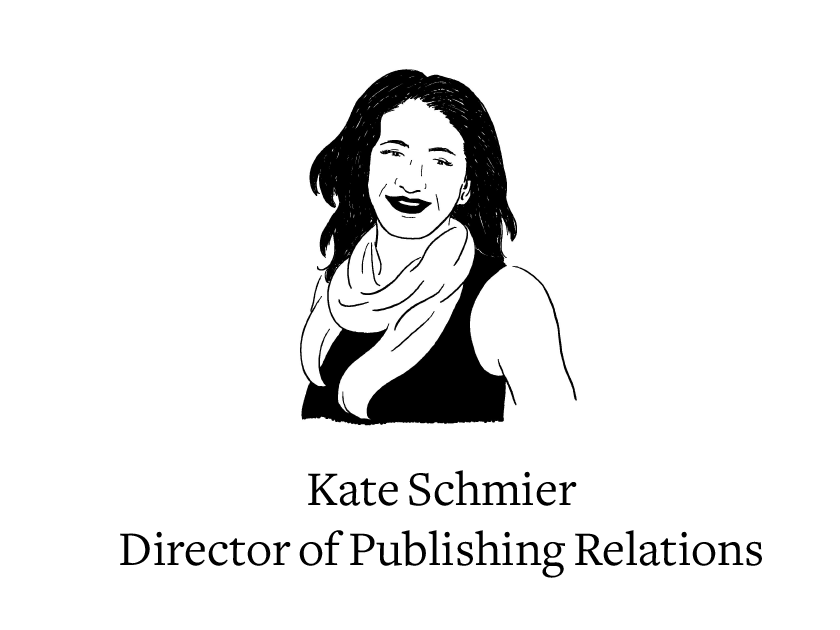
JBC is thrilled to welcome Kate Schmier as our first ever Director of Publishing Relations. We chatted with Schmier about the Jewish books that have inspired her over the years and her passion for Jewish Book Council’s mission.
JBC Staff: Can you speak a bit about your career/professional background and where Jewish books and authors have had an influence on your work?
KS: I come from a family of storytellers, especially my two strong, feisty Jewish grandmothers whom I miss dearly. For me, writing has always been a creative outlet. My Jewish identity has often influenced my stories – from the time my best friend and I decided to write “A Hanukkah Carol” in the third grade to my novel-in-progress loosely based on my own matriarchs. After studying creative writing at the University of Michigan, I moved to New York City and landed my first editorial job at Hearst Magazines. A couple years later, I realized I wanted to use my writing to support causes I believed in, so I transitioned to the nonprofit sector. I held various roles at philanthropies (and most recently, a mission-driven startup), which allowed me to build a diverse skillset in strategic communications, content marketing, partnerships, and advocacy.
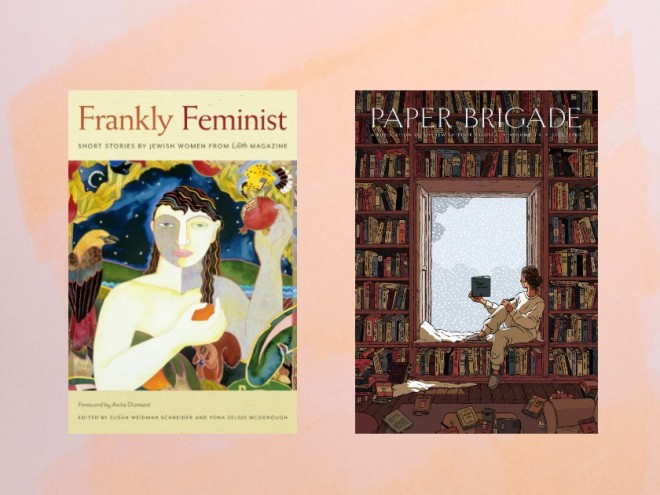
Along the way, I kept writing, both as a freelance journalist and as a fiction writer. I earned my MFA in fiction from Sarah Lawrence College, where I met fellow writers who have remained important parts of my creative life to this day. In recent years, I’ve been grateful to form close relationships within the Jewish writing and publishing community, through my work for Lilith, Paper Brigade, and other outlets. I couldn’t be more thrilled to step into this exciting new role, which will enable me to combine my professional background with my passion for Jewish books and storytelling.
JBC Staff: Can you speak on when you first learned about Jewish Book Council and our work? What excited you about our mission?
KS: I first got acquainted with Jewish Book Council when I discovered its literary journal Paper Brigade. I was particularly struck by the short story “Into the Mud” by Dutch Israeli author Yael van der Wooden, whose debut novel, The Safekeep, went on to garner significant accolades, including a National Jewish Book Award. After a few attempts at publishing my own fiction in the magazine, I’ll never forget when Fiction Editor Josh Rolnick’s email landed in my inbox, letting me know that my story, “The Virgin Grandmother,” had been accepted! Josh, as well as Editorial Director Becca Kantor and then Executive Editor Carol Kaufman, took such wonderful care of my story – and I know their incisive edits made it that much stronger. Through the publication process and related events, I got to know the JBC team and wider community of authors and supporters. This only increased my admiration for the organization and its important mission.
Since then, I’ve remained involved as a reader of fiction submissions for Paper Brigade and as a regular attendee at JBC author events and convenings. So, when I learned of this new role, I jumped at the opportunity to join the team in a more official capacity. At this complex moment, I believe JBC’s efforts to elevate Jewish stories – and ensure they continue to have a place in the publishing world – have never been more crucial. I look forward to partnering with the team and with leaders across the publishing industry to advance this vital work.
I come from a family of storytellers, especially my two strong, feisty Jewish grandmothers whom I miss dearly. For me, writing has always been a creative outlet.
JBC Staff: Can you share some of your favorite Jewish books or authors?
KS: I was fortunate to study with the great Joan Silber during my time at Sarah Lawrence College. I loved Joan’s most recent novels-in-stories, Improvement, Secrets of Happiness, and Mercy (which I got to review for Lilith). Joan has a signature style in which a minor character in one story or chapter becomes the main character in the next – allowing her to take the reader on a journey across time, continents, and lives. I greatly admire her books’ expansiveness and poignancy.
Over the past few years, some of the most memorable Jewish books I’ve read were by debut authors. As I mentioned, I loved Yael van der Wooden’s The Safekeep, a gorgeously written novel about two women living in the Dutch countryside in the aftermath of the Holocaust. Another recent favorite was Zeeva Bukai’s first novel The Anatomy of Exile, a powerful portrait of a Mizrahi family.
I also adored the story collection A Small Sacrifice for An Enormous Happiness by Jai Chakrabarti, another author whose work I got to know through JBC. Each story in the collection is masterful, but I particularly enjoyed “Searching for Elijah,” which explores themes of family and identity through the lens of an Indian widow who falls in love with a Jewish man.
JBC Staff: Is there any book that has left a major mark on your life, or shaped you significantly?
KS: One book that had a profound impact on me was To the End of the Land by David Grossman. I read it early into my relationship with my Israeli husband, when I was seeking a more nuanced understanding of the place where he was from. In the novel, Ora, a mother whose son is sent back to the front during his military service, embarks on an epic hike through the Galilee – convincing herself that if she is not home to receive bad news, she can somehow protect her child. Grossman brought me into the mind of this complex, deeply human character, allowing me to feel her fierce love and anticipatory grief. It reminded me of literature’s power to plunge us into another person’s consciousness – and it offered me a window into a culture I never could have understood from headlines alone.