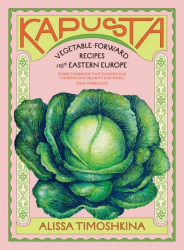
The spoon is the most ubiquitous of all cutlery. Across continents and culinary cultures — amongst those who eat with forks, hands, and chopsticks — spoons are universal. They are used for our first foods, our last, and everything in between. The spoon helps us to consume nourishment from bowls full of comfort. And, as Alissa Timoshkina explains, “its soft, smooth shape is inviting and safe, it can do no harm” unlike other pieces of cutlery. With this framing, Timoshkina invites readers to explore the world of comforting Eastern European soups, stews, dumplings, and sweets that are eaten with a lozhka, a spoon.
The first thing readers will notice about this cookbook is that it is gorgeous. Consistent with the author’s previous cookbook, Kapusta, the look and feel of this book is rustically simple and undeniably charming. The just-glossy-enough photographs, which could have been staged in a well-lit home in some long-ago shtetl, reinforce the Eastern European heritage of these dishes and balance the soft, matte colors of the rest of the book. Also, the paper is just heavy enough, with pages easily staying open to whichever recipe catches your eye. Though photographs and feel are not why you should buy this book, they will make your experience (re)reading and (re)using this cookbook even more pleasant.
It would be inappropriate to present Eastern European spoon-based dishes without the iconic Ashkenazi canon of cholent and matzo ball soup. In framing cholent, both for her Jewish and non-Jewish readers, Timoshkina explains this dish and what it means for her as a non-Orthodox Jew who grew up in the Soviet Union. This sociocultural framing is important because it ties together many of the threads in this book and explains why Timoshkina includes a handful of recipes that are not kosher (but can be easily adapted). This also explains why there are two very different cholent recipes, one that is explicitly Hungarian and another that is more Polish (but with pomegranate molasses where many recipes would use ketchup). In her explanation of Jewish “Penicillin” Chicken Soup with Kneidlach Dumplings, Timoshkina explains how matzo balls are related to other regional dumplings and why they are superior to their German antecedents: matzo meal offers much more complexity and subtlety than a dumpling made with just wheat flour.
The recipe for Sima’s Beetroot and Hazelnut Jam (eingemachts) is worth highlighting. This dish largely fell out of favor in the 1940s with compounding effects of the Holocaust, assimilation, and the rise of commercial jams and preserves that replaced those made by Jewish housewives. But in the Soviet Union (and a scattering of homes in the Diaspora), amidst austerity and frugality, this slightly spicy magenta jam was preserved and served, often on Passover, as a marker of family heritage. Lozhka is filled with many such comforting dishes inextricably linked to culinary histories and identities from this region, including Jewish, Roma, Tatar, and dozens of other ethnicities and nationalities.
Most of the recipes in Lozhka are traditional and multigenerational. They are presented with their own legacies and identifying markers. Baba Sarah’s Cherry Soup, a recipe provided by How to Share an Egg’s Bonny Reichert, is emblematic of Ukrainian (and neighboring) sour cherry soups. The incredibly simple Zupa Koperkowa i Lane Kluski (Polish Dill Soup with Drop Dumplings) represents an oeuvre of “thrifty Eastern European cooking.” Timoshkina continuously serves up warm invitations to explore the diverse Eastern European region with a spoon through dishes such as Mancare de Mazare (Romanian Green Pea Stew with Chicken Meatballs and Lots of Dill), Kulajda (South Bohemian Wild Mushroom, Potato and Sour Cream Soup with Eggs), Armenian Lentil Soup with Prunes and Walnuts, Żurek (Polish Easter Soup with Wild Mushrooms and Fermented Rye), and multiple variations of Hungarian Lecsó.
And yet, this book is not prescriptive. There are many modern adaptations that bridge Timoshkina’s multiple identities and culinary repertoires into a delightful fusion. For example, her adaptations of shakshuka and baked beans wrap popular North African – Israeli and British (respectively) dishes in cozy Romanian, Bulgarian, and Hungarian sweaters. In doing so, Timoshkina acknowledges how foods are constantly in conversation with their new surroundings, picking up new accents, flavors, styles, and additions along the way.
Avery Robinson is a Jewish nonprofit professional living in Brooklyn. In his spare time, he freelances as an editor, culinary historian, cofounder of the climate change nonprofit Rye Revival, and manager of Black Rooster Foods. His writings have appeared in Marginalia Review of Books, Jerusalem Post, TabletMag, and The Forward.