Join a community of readers who are committed to Jewish stories
Sign up for JBC’s Nu Reads, a curated selection of Jewish books delivered straight to your door!
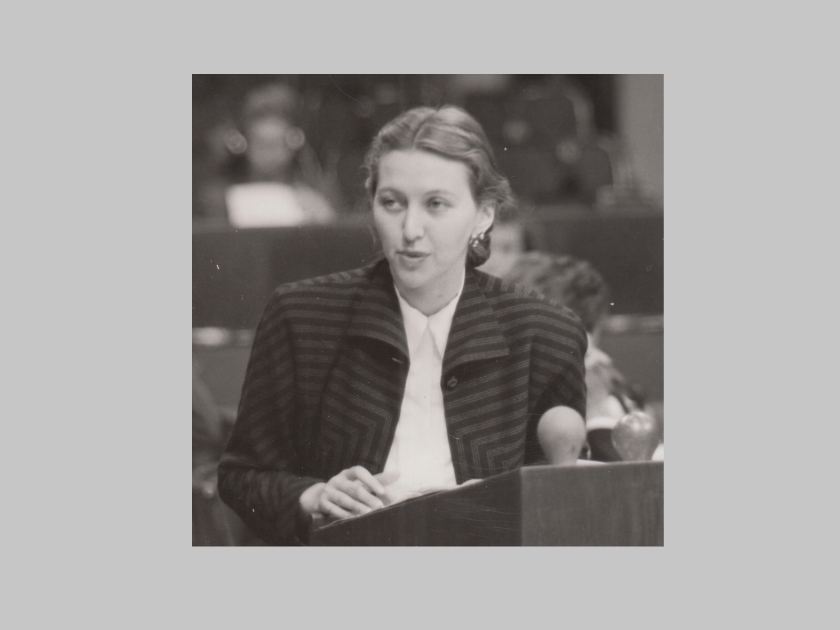
Belle Mayer (Belle Mayer Zeck) U.S. prosecution layer at IG Farben Trial, part of the Trials of War Criminals before the Nuremberg Military Tribunals (NMT) in the late 1940s
National Archives at College Park — Still Pictures
In the solemn galleries of London’s Imperial War Museum there is a simply framed six-foot oil painting depicting the dock of Courtroom 600 in Nuremberg’s Palace of Justice. It portrays twenty of the twenty-one Nazi leaders who appeared there between 20 November 1945 and 1 October 1946 to face charges of crimes against peace, war crimes, crimes against humanity, and conspiracy to commit these crimes.
The defendants do not look like killers but weary bureaucrats. Their aging heads are weighed down by cumbersome headphones, they wear ill-fitting suits, and their shoulders are hunched as they pore over sheaves of papers or stare off into space. One figure in the center foreground clutches his head. The gesture is ambiguous: is he dismayed, racked with guilt or shame, or simply exhausted and defeated? Two rows of lawyers in black robes sit just in front of the defendants. They too bow their heads, to study their papers, and frown as they listen to the evidence being translated and relayed through their headphones. Behind the prisoners stands a line of white-helmeted guards in smart green uniforms. They look young and upright, morally and physically, by comparison with the slumped ranks of officials and defendants.
The true power of the painting lies farther into its background. The far wall of the courtroom has been obliterated to show fire and ruin, heaps of bodies, starvation, grief, and despair — the catastrophe wrought by the men in the dock. Smoke rises over twisted metal and the rubble of bombed-out houses. On the horizon, the war is still blazing. And just in front of the unseeing men, on the defense’s benches, are piled naked corpses: their victims. On the very front bench, a thin white arm (corpse or survivor, we cannot know) slips into the courtroom.
This painting was commissioned to capture an unprecedented moment: the first time in history that former leaders of a regime would be held to account in an international tribunal. Its mood is desolate and yet curiously mundane. It depicts a working court, but this is no ordinary workplace. It shows a reckoning with years of systemic horror, a procedural effort to ascertain whether justice can find the words to describe evil and the mechanism to punish it. Because there is evil in the room. You can see it in the stricken expressions of the lawyers, in the flat gazes of the accused. It hangs in the air along with sour sweat and anxiety.
I have seen reproductions of this painting so many times that the image is seared on my mind. This is the Nuremberg I have come to know: a courtroom crammed with lawyers, Nazis, and military. This Nuremberg features a roll call of famous and infamous men. There is the American chief prosecutor Robert Jackson, whose opening speech was broadcast all over the world; the principal defendant Hermann Göring, whose mendacious charisma observers found endlessly compelling; there are celebrity writer-reporters like John Dos Passos and groundbreaking legal theorists like Hersch Lauterpacht.
But the more familiar I became with the image, the more I found it impossible to see beyond a glaring absence.
There is not a single woman in the picture.
Not in the dock, nor in the row of military personnel behind it; not on the benches full of lawyers, nor the crowded tables that linger hazily in front of the disappearing back wall. The painting presents the story of a modern Armageddon conducted by men, fought by men, inflicted on men, prosecuted by men, and, ultimately, judged by men. It’s a picture of the bloodiest catastrophe in human history with half of humanity painted out.
The Second World War, more so than any other war before it, was also fought, suffered, endured, chronicled, and, as I hope this book will show, ultimately witnessed and prosecuted by women. Roughly 350,000 women served with the US armed forces in the Second World War, and about one in five of the French Resistance were women; 640,000 women served in the British armed forces as part of organizations such as the Women’s Royal Naval Service, the Women’s Auxiliary Air Force, and the Auxiliary Territorial Service. Journalists who were women made their way to the front lines in the course of the conflict, demanding the right to report from wherever men did. And growing up as the granddaughter of Holocaust survivors, I was intensely aware that the crimes the Nuremberg war trials prosecuted were as painfully relevant to women’s history as men’s. The numbers barely tell the story of female victims of the Holocaust: 2 million of the 6 million who were murdered were women; there were camps, like Ravensbrück, where only women were murdered. Within the Third Reich, at least 35,000 women were trafficked and raped via a network of 500 brothels, while the number of women raped in the occupied Soviet Union alone may have been as high as 10 million. And yet, when it came to the Nuremberg trials, the moment of accountability for these barbarous crimes, I was met by the same male cast. Countless books, films, and documentaries told the story of Nuremberg. I never asked why there were no women among their number.
Confronted by the painting, I looked again. In what would later feel like an uncanny foreshadowing of everything I learned while writing this book, I had to lean in and look carefully in order to see the signature at all. The painting was the work of Laura Knight, a British woman. She had painted the scene from life.
Laura Knight was sixty-eight when she arrived in Nuremberg. A highly successful painter sent there by the War Artists Advisory Committee to record what was happening in the courtroom, she arrived feeling awestruck by the magnitude of the task. As well as capturing the scene in oils, she meticulously documented her experience in a diary. Stored in her archive in Nottingham and composed in blue ink on loose sheets of paper, it recounts her personal experience at the trial in vivid and gripping detail. It set me on a path to find the other women who, like her, had been left out of the picture.
I found the reporters first. Many of the writers and journalists who came from across the world to cover the trials were housed in a castle belonging to the Faber-Castell family on an estate in Stein, just a few miles southwest of Nuremberg. In a neat accident of history, those professionally tasked with writing the story of the Nuremberg trials were housed on the estate of a family who had become rich by manufacturing pencils. The men were accommodated in the castle, the women in an old dower house known as the Faber-Castell villa, where they shared a single derelict bathroom plumbed with a urinal. They drank each other’s vodka, edited each other’s copy, and debated the biggest issues of the day, including justice, gender, and the postwar order. If journalism is the first draft of history, then the first draft of the history of the Second World War and the Holocaust was written at the Faber-Castell estate, and plenty of it by women.
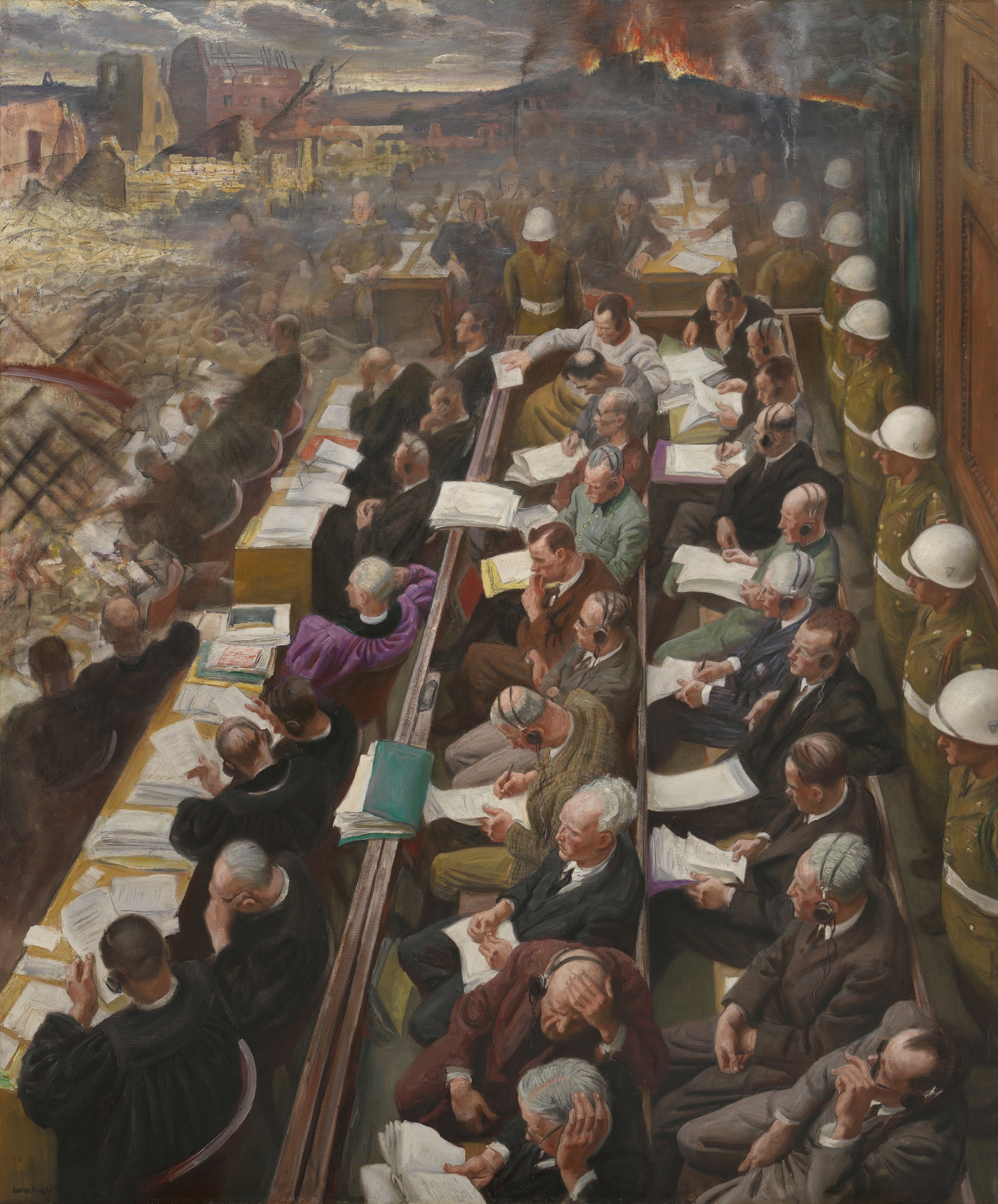
The Nuremberg Trial by Laura Knight, 1946
Imperial War Museum London, via WikiMedia Commons
From THE NUREMBERG WOMEN: The Untold Story of the Eight Women Who Brought the Nazis to Justice by Natalie Livingstone. Copyright © 2026 by the author and reprinted by permission of St. Martin’s Publishing Group.
Natalie Livingstone graduated with a first-class degree in history from Christ’s College, Cambridge. She began her career as a feature writer at the Daily Express and contributes to Tatler, Harper’s Bazaar, American Vogue, Elle, The Times and The Mail on Sunday. She is the author of The Mistresses of Cliveden, The Women of Rothschild and The Nuremberg Women. Natalie is also the founder and chair of the annual Cliveden Literary which she launched in 2017.