Join a community of readers who are committed to Jewish stories
Sign up for JBC’s Nu Reads, a curated selection of Jewish books delivered straight to your door!
There was a problem. The ghetto bench law — the rule forcing Jewish students to sit in a segregated bench in university classrooms that was increasingly popular in Poland in the 1930s — was instituted at the University of Warsaw in the fall of 1937. But in my newest draft of my historical novel, I’d shifted parts of the story around, and the ghetto benches were suddenly happening in the spring. (Lesson learned: always write fiction in a place with limited seasons so you can chop and change bits without having to endlessly rewrite weather.) But could I morally alter the date of this discriminatory rule’s implementation from fall 1937 to spring 1938? I was riddled with worry.
One of my mentors on the project, a novelist, tried to shake me out of my angsty historian armor. “Judy! No one knows anything about the ghetto benches, and your readers won’t mind if you move them by a few weeks. Besides, it’s a novel – it’s fine!” But was it? After years of working on a nonfiction book that had to be right, I was now writing a make-believe story. Shifting my mindset from documenting history to creating historical fiction was not always easy as I was faced with myriad instances where I needed to alter when real life events occurred for my characters and plot.
My last book, The Light of Days: The Untold Story of Women Resistance Fighters in Hitler’s Ghettos, told the true story of young Jewish women and teenage girls who fought the Nazis within Polish ghettos, working as secret couriers, blowing up Nazis trains, and planning ghetto uprisings. I was sharing a Holocaust history that had not been widely told, about real people, and I felt a great responsibility to tell the real-life accounts as correctly as could be. As a former academic historian and museum researcher, I had previously found myself on the scholarly stand and had supervisors who instilled in me the importance of historical accuracy for institutional credibility, I wrote TLOD anticipating crossfire and backlash. That book had seventy-three pages of endnotes and bibliography, and it was a select bibliography at that.
Writing TLOD also led me to ask questions about the world that created these brazen, daring and lipstick-and-pants-wearing young Jewish women. I began to look into 1930s Poland, and found it was nothing like the crumbling and impoverished grey shtetl I’d imagined. Jewish women were educated, emancipated, and employed. Warsaw overflowed with theaters, a flourishing literature scene, and nightclubs with revolving dancefloors and fashion shows. It was called “the Paris of the North.” Fascinated by this setting that I knew so little about (but should have known!), and inspired by the hundreds of memoirs I’d read by Jewish women in Poland, as well as my own two grandmothers who spent their young adulthoods in the Polish capital, I decided to explore this rich setting in fiction. My protagonists, the feisty Fanny and the intellectual Zosia, were immediately born in my head and I was thrilled to finally be able to guiltlessly make up dialogue!
What needs to be conserved and what can be altered for the sake of the story? How should I balance my instinct to preserve and protect the truth, with my need to create a compelling tale?
But switching genres sometimes left me paralyzed. It wasn’t that I wasn’t imaginative. Deep in my digital files is an unpublished novel featuring God as a Bikram yoga devotee with a large dog and a younger girlfriend who’s camping out in his basement sublet in West Chelsea; I recently did the rounds pitching an animated TV series about a pipe-smoking Boston Brahmin suffragette who is having an affair with a sardonic ghost. But this was different. Not only had I spent years writing factually about this period, but this was a story related to the Holocaust. I felt a great responsibility to share it with sensitivity and a degree of veracity. Indeed, the truth of the time and place is a great part of the novel’s draw; it is very important for me to share this largely misconceived world which so resembles our own. Interwar Poland was rife with contradiction. The Jewish and Polish peoples were negotiating their post-World War One identities in light of geopolitics and modernism, considering questions like are we, Poles, an ethnic-nation state or a diverse country? Are we, Jews, a nation, a religion or a culture? Meanwhile they created and consumed art prolifically — jazz shows, art exhibits, comedy sketches, dance competitions. Picture Josephine Baker performing to adoring crowds. At the same time, democracy was threatened, the Jewish community was divided into various political factions, and nationalistic and Nazi ideology began to spread, in particular, in universities. I wanted to highlight these timely realities, but was confronted by the question of what could be changed, ethically?
I thought of my favorite fictional historical books and TV series of which there are literally hundreds. Some of my absolute tops are the zaniest of all—The Great, Another Period. These narratives are very far removed from history, absurdist and ridiculous some might say. But still I learned about the time and place. I even looked things up when I wondered what really happened. (How much opium did they smoke?!) These madcap shows moved me to research.
Then I thought of my own experiences adapting The Light of Days into a movie. As I shared with my writing teams, I had no problem enhancing relationships and molding composite characters; I said an uncomfortable ok to some gratuitous seduction and reluctantly agreed to a bit of sexing up. But when one writer suggested a scene where a train full of Jews wearing kippahs rolls out of Poland into Hungary on a great escape ride in 1944, I put my foot down. This, I knew instinctively, was too far a fiction, especially for this realistic Holocaust project. And it wasn’t necessary for the story.
What needs to be conserved and what can be altered for the sake of the story? How should I balance my instinct to preserve and protect the truth, with my need to create a compelling tale? Even in nonfiction, certain elements of the work are emphasized and others omitted for the sake of clear and cohesive narrative.
In memoir, we talk about the importance of emotional truth over factual truth. Sometimes, we must serve the story. In this novel, I reasoned, by allowing for a bit of flexibility with the historical calendar, I was able to create sharper narrative tension, and thus, hopefully, a book where a reader wants to turn each page – a book that utterly absorbs them. No one would appreciate any of this world if I couldn’t spin a sizzling yarn.
But I did add an author’s note at the end of the book, explaining all my research and alterations. Once a neurotic historian, always a neurotic historian.
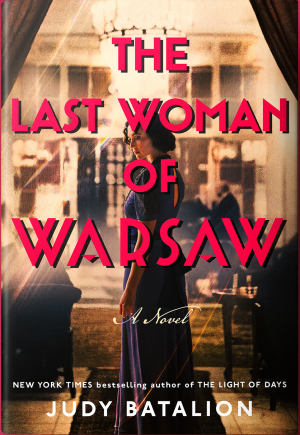
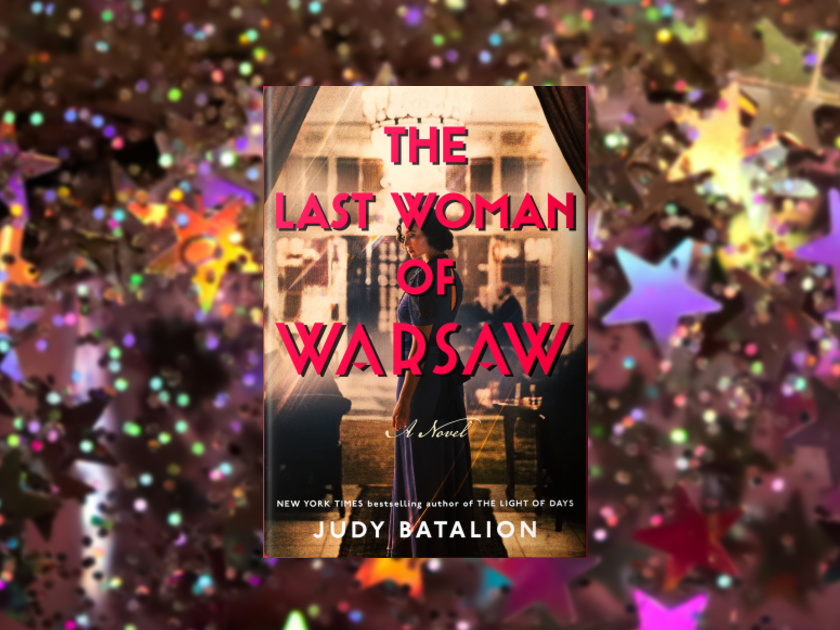
The Last Woman of Warsaw by Judy Batalion
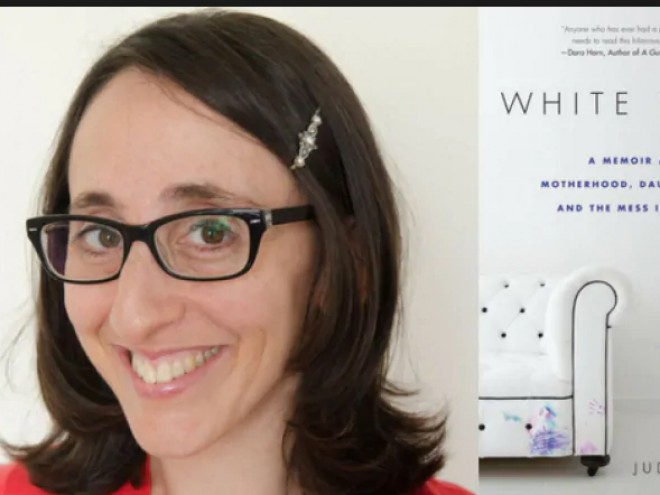
Judy Batalion is the author of several books of award-winning nonfiction, most recently The Light of Days. Judy’s work has appeared in The New York Times, The Washington Post, Vogue, The Forward, Salon, The Jerusalem Post, and many other publications.