Join a community of readers who are committed to Jewish stories
Sign up for JBC’s Nu Reads, a curated selection of Jewish books delivered straight to your door!

The Great White Way — Times Square, New York City, 1925, New York Historical Society
Monty Python’s Spamalot was back on Broadway this past season, and with it, the infinite wisdom imparted by Michael Urie as Sir Robin: “So, listen, Arthur darling, closely to this news: we won’t succeed on Broadway if we don’t have any Jews.”
Funny. But what exactly is Sir Robin saying?
Well, it’s no secret that before the advent of the jukebox musical, virtually every successful Broadway composer (Cole Porter being the most prominent exception) was Jewish: Rodgers and Hammerstein (and Hart), Kander and Ebb, Lerner and Loewe, Berlin, Bernstein, Weil, the Gershwins, Kern, Styne, Comden and Green, Loesser, Coleman, Bock and Harnick, Strouse, Herman, Sondheim, Hamlisch, Schwartz, Menken, Shaiman, and even Les Misérables composers Boublil and Schoenberg, and Rent creator Jonathan Larson.
And it’s also no secret that Broadway audiences skew Jewish. Is there ever a Wednesday matinee day when Times Square isn’t filled with temple groups from Long Island?
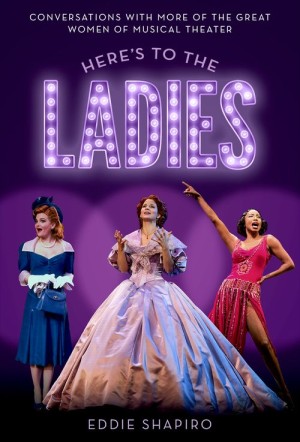
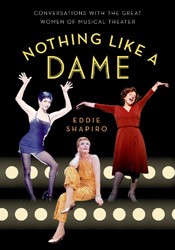
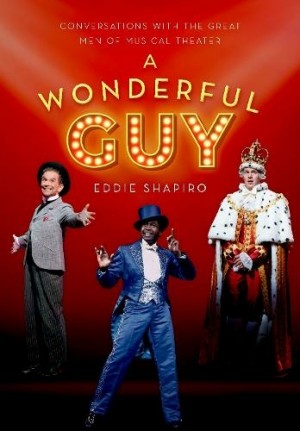
For my books—Nothing Like a Dame, A Wonderful Guy, and the latest, Here’s to the Ladies—I had the honor of talking with some of the greatest performers, several of them Jews, including Joel Grey, Bebe Neuwirth, Idina Menzel, Judy Kaye and Marc Kudisch. They have all played Jewish characters on Broadway, but of all of the people I spoke to, Judy Kuhn may have had the most opportunities to dig into her heritage on stage.
Kuhn is probably best known as the singing voice of Disney’s Pocahontas. (The film’s music was written by Menken and Schwartz.) But her first principal role on Broadway, right before she hit it big as the original Cosette in Les Mis, was in the short-lived musical Rags (Strouse and Schwartz), with a book by Fiddler on the Roof author Joseph Stein. It was, as Kuhn describes it, a sort of sequel to Fiddler. At the end of that show, Tevye and Golde set off for the new world. Rags begins when a boat of Jewish immigrants, much like the one Golde and Tevye would have been on, hits Ellis Island. Kuhn’s character, Bella, gave the show one of its most memorable moments when she wailed the show’s titular number about the oppression of the ghetto before perishing in the infamous Triangle Shirtwaist Factory fire.
Tzedakah may not be a conscious guiding principle for most performers, but really, what is a life in the theater if not one of service?
A decade later, Kuhn starred in King David by Menken and Rice, and then, in 2016, she played Golde herself, both on Broadway and in London’s West End. This past year, she won an Outer Critics Circle Award for her run in a revival of I Can Get It For You Wholesale—the show that put Barbra Streisand on the map in 1962 — and she just concluded a run in Titanic, playing Ida Straus.
Kuhn told me that when she first considered pursuing musical theater, she felt a sense of guilt. “My father … was an activist and civil rights lawyer. I said, ‘I should do what you do and help change the world.’ He said, ‘You should not feel guilty about doing what you want to do. You have to do what you love and what you’re good at or you won’t do anybody any good. But a little bit of guilt about the privilege that you’ve had and the gifts you’ve been given is good, because that will make you give back and you will find ways to contribute.’ I have always tried to live by that motto. I can always be better but that was a gift.” Tzedakah may not be a conscious guiding principle for most performers, but really, what is a life in the theater if not one of service? An actor gives with her entire body and soul to serve the playwright and creators, the director, and, ultimately, the nightly audiences who come to be moved, awakened, and awed. Actors, like all artists, embody the very tenets of our faith.
But don’t take my word for it. As the song goes:
There’s a very small percentile who enjoys a dancing gentile.
I’m sad to be the one with this bad news.
But never mind your swordplay, you just won’t succeed on Broadway,
If you don’t have any Jews.
Eddie Shapiro is the author of Nothing Like a Dame: Conversations with the Great Women of Musical Theater, A Wonderful Guy: Conversations with the Great Men of Musical Theater, and hundreds of articles in magazines with much shorter and more sensible titles than his books. He lives in New York City and Los Angeles.