Join a community of readers who are committed to Jewish stories
Sign up for JBC’s Nu Reads, a curated selection of Jewish books delivered straight to your door!
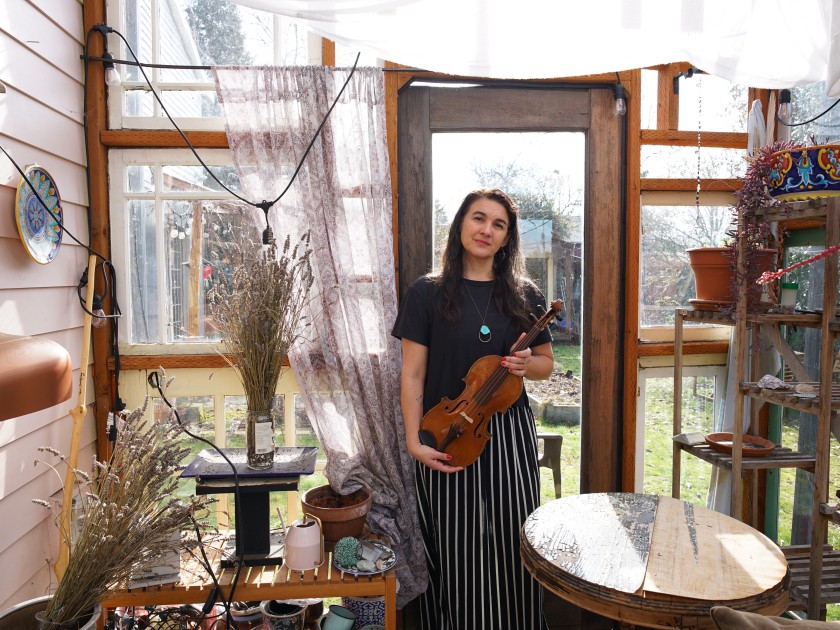
Author photo by Dao Strom
Often Dayenu is the soundtrack for wildly creative people who over a lifetime generate a range of projects. Consider Alicia Jo Rabins. It would have been enough to be the violinist in the klezmer punk band Golem. It would have been enough to have the first performance of the Girls in Trouble song cycle at the Jewish Museum in New York in 2008. It would have been enough to create a rock musical, A Kaddish for Bernie Madoff (2014). It would have been enough to win the APR/Honickman First Book Prize (2015) for the poetry collection Divinity School. It would have been enough to have a second poetry collection, Fruit Geode, be a finalist for the Jewish book award (2018). It would have been enough to have the rock musical A Kaddish for Bernie Madoff adapted as a film (2021). It would have been enough to publish an essay collection, Even God Had Bad Parenting Days (2022). None of this was enough, now Alicia Jo Rabins brings us the spiritual memoir When We’re Born We Forget Everything. Dayenu!
Julie R Enszer: What prompted you to write a memoir, specifically a spiritual memoir, at this point in your creative life?
Alicia Jo Rabins: I didn’t set out to write a memoir! I was very happy being a poet, actually, but once I was giving a poetry reading at a writing conference an agent approached me and said, “You should try writing nonfiction — you have a voice.” She wasn’t offering to represent me, just making a friendly suggestion, and she added that nonfiction really sells, as opposed to poetry. (Ouch.)
Struggling artist that I am, this definitely piqued my interest. I decided to follow her advice and write a nonfiction book. Then I had to decide what to write! I settled on a book about Biblical women from a feminist perspective, since this is a subject I’ve long studied and taught. But when I pitched the idea to another agent, she said, “It’s a nice idea, but you’ll need some personal narrative woven throughout or it will be too academic.” So I started to write a bit about my own spiritual path, and I found that the stories just kept pouring out of me. Before I knew it, I was writing a spiritual memoir with Biblical women’s stories interwoven, instead of the other way around.
JRE: Is there a particular imagined audience to whom you were writing while working on this memoir?
AJR: I don’t really imagine a specific audience per se when I write, but as a reader and seeker myself, I love reading stories of transformation, seeking, and learning; I also spend a lot of time teaching both teens and adults, being present inside the questions with them. So I think there’s a place in my heart where I go when I’m writing, which is the same place I go when I’m teaching Torah — an expansive field of seeking, curiosity, and vulnerability, the state of being on the edge of what we know and that which we are discovering, and holding all human experience with love and curiosity.
JRE: The structure of the memoir intrigued me, particularly how you interlaid the stories of women from the Torah within the book. Could you elaborate on structure in When We’re Born We Forget Everything?
AJR: Well, now that you’ve heard in the question above about the inside-out way I ended up writing this book, maybe it makes more sense!The full story is that for a long time I struggled to decide whether the Biblical women’s stories and my own were two separate books, or one. I just couldn’t figure out the answer. One day I walked past our local witchy supply store (crystals, incense, etc. — I’m in Portland), I saw a tarot reader was offering walk-in readings. I got one, and although I hadn’t said my question out loud, the reader kept turning over cards about integration and holding two opposites in one place. I took that as a sign and decided to combine the projects!
JRE: There are many wonderful vulnerable moments in When We’re Born We Forget Everything. Where do you feel most exposed as the book publishes?
AJR: Oh my gosh, thank you for correctly assuming that I feel exposed, it’s true — I feel like a peeled tomato. It’s like there are two parts inside me: the writer, who just wants to tell a story as best I can and, as long as it’s ethical, has no limitations on what I’m willing to disclose for the sake of art; and the private, shy, introverted part of me, who is sitting here thinking, “What the heck are you doing???” Fortunately, I’m fairly used to this feeling, because my job as an artist is to be vulnerable in front of people. I try to mostly focus on the gratitude that this project I’ve worked so hard on for ten years is coming out. But I am definitely taking a lot of deep breaths these days. I think it’s less any particular aspect of or moment in the book, and more the general shame of being seen, which is a feeling I’ve always been fascinated with.
JRE: I was very moved by the moments in When We’re Born where you name loneliness. They felt true and universal. How do you think about loneliness while writing this book?
AJR: Thank you for saying this. I had no idea I was writing about loneliness until one of my early readers named it as one of the main themes of the book. It was a total surprise to hear that, and a huge help because then I was able to think more consciously about the role of loneliness in the book in future drafts. Loneliness became a sort of character in the book, a recurring character, and looking back I think it often showed up (and shows up) to point me towards places where I need to grow, ways in which I need to get to know myself better, find more peace inside myself, connect more to the Divine, as well as asking how I can be of service to others in those moments.
JRE: How does loneliness show up in your life today? How do you greet it?
AJR: I’m not sure why, but the acute sense of loneliness I’ve felt on and off for most of my life has been lessening in recent years. It may be because of getting older, which I am definitely noticing has some deep internal shifts. It’s very possible that writing this memoir has something to do with it, because I think I have come to understand myself better through telling (one version of) my story.
Also, I’ve done a lot of internal work in recent years to learn to befriend myself. I used to feel like I had an empty space at the core of me, which I was looking to fill, and I only knew if I was doing okay based on external reflections. I’ve gone through a huge process in the past ten years of shifting my center of gravity inward (yay, forties!), and now I feel much more able to keep myself company, which is a huge gift. I still get knocked off balance all the time, of course, but now I have the ability to return to myself in a different way.
JRE: It strikes me that one of the important pieces of work that When We’re Born We Forget Everything does is articulate a subjectivity of a seeker. What does it mean to be a seeker?
AJR: I absolutely identify as a seeker, and I love your phrase, “articulate a subjectivity of a seeker.” I think some of the most intense journeys we embark on in life are inner journeys, and that subjectivity is a wild ride! I’m constantly wondering how to balance our objectively infinitesimal, brief existence with the overwhelmingly powerful experience of subjectivity and self. How to inherit wisdom from our ancestors; how to work with time, ego, the body, and relationships while we’re here; how to pass it on to future generations – these are questions I’m hopelessly obsessed with!
I believe in vulnerability, and for better or worse, I’ve always had the instinct to drop directly down into the mess of my own emotional experience as a way of making art. That raw vulnerability is the place I create from, and it’s where I go when I perform as well.
JRE: Do you imagine When We’re Born We Forget Everything in some ways galvanizing the idea of being a seeker?
AJR: It hadn’t really occurred to me in those words, but I have often said that if my book inspires or gives someone permission to write (or just try to understand) their own story, I’d be very glad. Maybe that’s a different way of what you’re saying — to name the fact that although we’ll never be writing “seeker” on our tax returns, meaning-making and storytelling is a powerful part of life. And at the same time, I hope that people who just like a good coming-of-age story will be entertained by this book.Sometimes “seeker” can feel a little gauzy, and I am most fascinated with what being a seeker means while we’re also living in the physical world, with all its messiness and relationships and frozen peas.
JRE: What are some things you do in your work in the world that promotes seeking as a way of being in and engaging the world?
AJR: I think I experience art-making as a form of seeking, and performance as a public version of that. I believe in vulnerability, and for better or worse, I’ve always had the instinct to drop directly down into the mess of my own emotional experience as a way of making art. That raw vulnerability is the place I create from, and it’s where I go when I perform as well. My other work is teaching Jewish studies. I teach teens and adults, and I specialize in working with b’nai mitzvah students who aren’t part of a synagogue, which means I spend a lot of time each week in deep discussion with a twelve-year-old (usually on Zoom), thinking together about the meaning of Torah, spirituality, and what it means to be Jewish. I try to model seeking in these lessons, making it clear that even though I’m the teacher, I don’t have answers to these deep human questions — we can ask them together, we can consider different possible answers, or we can even just sit in the not-knowing together.
JRE: Living and studying in Jerusalem is an important part of the memoir and your path to Jewish practice. What practices and rituals are helping you to navigate this difficult moment in our history between Israelis and Palestinians?
AJR: I am a humanist; my priority is to do what I can to protect those who are in physical danger, while refusing to dehumanize anyone. As a diaspora Jew, it feels important to acknowledge that key years of my spiritual transformation happened in Jerusalem, and that my time there was meaningful. I feel a timeless love for the sacred city of Jerusalem, which has passed through many empires in its history, and I want Jerusalem to be equally accessible to all people of all faiths. At the same time, I feel shame that the government of this country, where I was able to connect so deeply with the tradition of my ancestors, is also causing such suffering.
In terms of practices and rituals, I pray for peace and justice; I donate to Palestinians in the West Bank and Gaza when I’m able; I educate myself; I speak and act according to my humanist ethics, and try not to pay too much attention to online vitriol. Over and over, I return to an ethos of love and compassion for every human being, both in prayer and in action.
JRE: When We’re Born We Forget Everything ends with an affirmation of ritual. You describe ritual as “there for us when we need it. To hold us; to carry us. To help us remember that magic is woven through the everyday like a thread of gold, and if we stop for a moment, we can find it.” Can you describe a ritual or two that are particularly meaningful to you right now?
AJR: I love individual prayer and the technology of blessings. Waking up and reciting a short blessing giving thanks to be back in my body is really helpful, whether or not I continue into a longer version of morning prayers. I love beginning each of my b’nai mitzvah lessons by reciting the Torah study blessing with my student (we both choose between masculine and feminine forms of the blessing each time). I always feel like we are walking through the gate of Torah study together, moving from regular life into sacred study. I love singing the Shema to my kids at night, and asking them to share one thing they are grateful for. And Shabbat dinner!
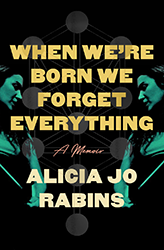
When We’re Born We Forget Everything by Alicia Jo Rabins
Julie R. Enszer is the author of four poetry collections, including Avowed, and the editor of OutWrite: The Speeches that Shaped LGBTQ Literary Culture, Fire-Rimmed Eden: Selected Poems by Lynn Lonidier, The Complete Works of Pat Parker, and Sister Love: The Letters of Audre Lorde and Pat Parker 1974 – 1989. Enszer edits and publishes Sinister Wisdom, a multicultural lesbian literary and art journal. You can read more of her work at www.JulieREnszer.com.