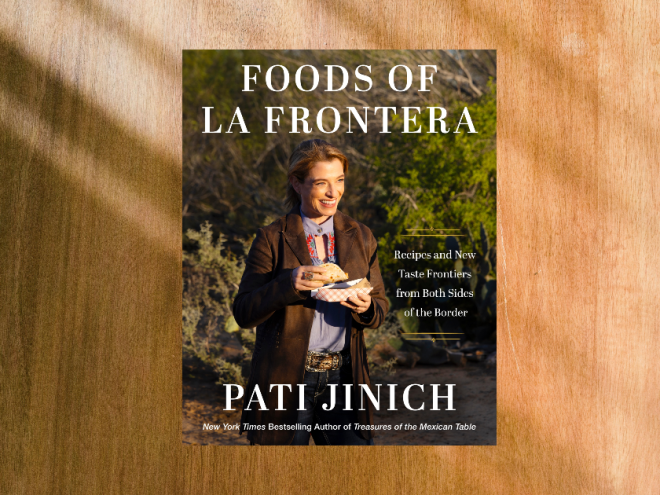
The James Beard Award – winning cookbook writer and television host Pati Jinich is perhaps best known for her series of cooking shows and docuseries with PBS. Now, with her fourth cookbook, Foods of La Frontera, she delves into the borderlands between Mexico and the US, which she explored in a similar television series she hosted from 2021 – 23.
The cookbook is the result of the ten years Jinich spent traveling through the region. La frontera (the term Jinich favors over the intimidating-sounding “the border”) runs for 1,954 miles, beginning in San Diego and Tijuana in the west and continuing all the way to Brownsville and Matamoros in the east. It is a massive stretch of land, and one that Jinich acknowledges has been hugely politicized in recent years.
The cookbook’s scope is equally large, spanning nearly 340 pages and featuring 125 recipes, with lush, sunny photographs and clear instructions, plus plenty of tips and personal anecdotes. The book starts with a lovely illustrated map of the borderland states and their key cities and is then divided into nine sections, including tortillas, masa, beans and rice; salsas; soups; seafood; vegetables; and, finally, desserts.
Some of the recipes might be time-consuming or require ingredients not readily available in mainstream American supermarkets (think tepary beans and more unusual chiles such as güeros or Colorado chile powder). But wherever possible, Jinich provides ingredient substitutions and time-saving measures. And also, as she notes, in a world with more permeable borders than ever, all of these ingredients she uses are available online.
The sense of existing between borders (“treading between two worlds,” as Jinich puts it) is a familiar one for the author. She is a citizen of both Mexico and the US, and growing up in Mexico City, she sometimes stood out as a “blue-eyed Jewish girl in a mainly Catholic country,” the granddaughter of Central and Eastern European immigrants. Foods of La Frontera contains interstitial articles with personal stories and recipes from the many different groups that make up the region, from Indigenous groups and Mennonites to the Chinese who built the railroads, as well as immigrants from Greece, Japan, Syria and more. This mix contributes to everything from Mennonite cheese empanadas and Chinese-influenced Mexicali shrimp and pork spring rolls to Greek lamb on a spit, “adopted by Mexicans” and served with salsa and tortillas.
The cookbook also shows that a number of beloved Mexican American dishes originated along these borderlands — nachos, burritos, margaritas, and even caesar salad, which was invented by a Mexican chef in a Tijuana restaurant. Furthermore, when Jinich asks one Rio Grande chef which food exemplifies the Texan borderlands, he immediately says “American cheese.” Foods of La Frontera shows how the melding of two cultures “enriches both of them at the same time,” while liberating them to form something new altogether.