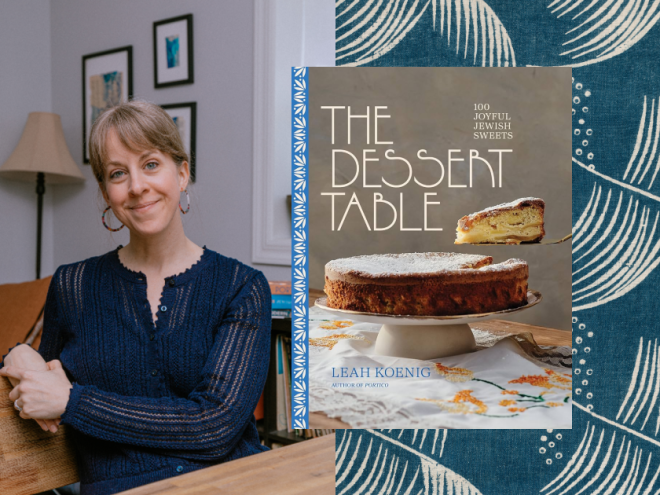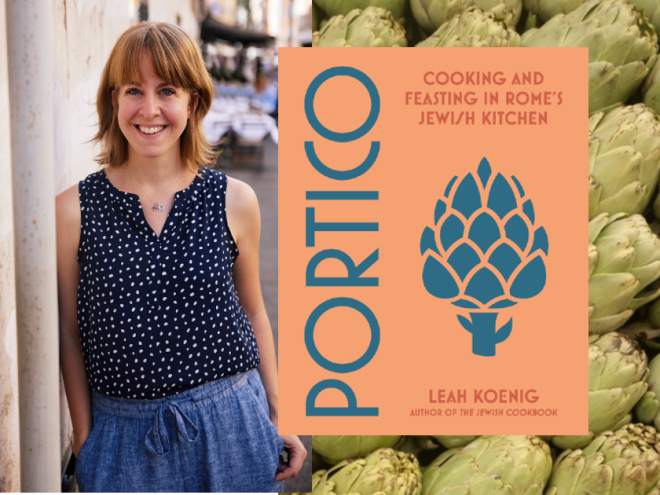
Leah Koenig is the award-winning author of eight cookbooks and the popular newsletter The Jewish Table. For her latest cookbook, The Dessert Table, she has returned to the world of Jewish sweets featured in her 2019 cookbook Little Book of Jewish Sweets—this time with quadruple the number of recipes.
The Dessert Table is very ambitious, comprising one hundred different sweets recipes from many different traditions: Ashkenazi, Sephardi, Middle Eastern/Mizrahi, and elsewhere in the Jewish diaspora. Koenig’s goal seems to be to celebrate the diaspora and the recipes that have come from all over the world to reach the States. Case in point: the introduction features a lovely illustrated map showing the primary place of origin for many recipes featured later in the book, among them melkert (milk tart) from South Africa, marunchino almond cookies from Spain, and chocolate-cinnamon palmiers from France.
Despite the book’s ambition, the recipes themselves are not overly complicated and are presented in an inviting way, with lush photography and ingredients that can largely be found in any supermarket. The structure of the book moves from cookies and bars to cakes all the way to doughnuts and babka, and ice cream and dessert drinks. Some recipes feature a twist on a classic (delicious-sounding caramelized white chocolate – lime babka or oatmeal – sour cherry hamantaschen) while others are more unexpected altogether, such as concord grape soda and flan (with no crust, it is “naturally Passover-friendly”). Seemingly on Koenig’s mind is elevating the desserts she enjoyed at synagogue in her youth, which were often “dry, overly sweet, and just generally ersatz.” Notably, all of the recipes follow kosher law; many are also pareve in that they contain no meat or dairy, or there are simple substitutions that Koenig has been thoughtful to outline.
It is indeed a very thoughtful cookbook, geared toward the home cook who would like to expand their baking repertoire or have a useful recipe on hand for any old day, or a holiday — Koenig features a list of the Jewish holidays early in the book, with some recipe suggestions. A recipe is never just a recipe, she seems to suggest, as they are often imbued with tradition or symbolism; for example, the apples and sweets eaten on Rosh Hashanah form an “edible symbol of one’s hopes for a sweet year ahead.”
Among the most enjoyable aspects of The Dessert Table are the short history essays woven into the book. One describes the Jewish involvement in the early chocolate industry in France; another delves into the pivotal role that Sephardi Jews of the fifteenth and sixteenth centuries played in helping the Dutch set up the cane sugar industry in Brazil (before being expelled in the 1630s). Similarly, Koenig discusses the Jewish origins of many American candies (including ever-popular Tootsie Rolls and Bazooka gum). These sweet details are tantalising enough that they could likely fill whole books of their own, but their brief inclusion is welcome and roots what could seem like frothy recipes to their wider history.