Join a community of readers who are committed to Jewish stories
Sign up for JBC’s Nu Reads, a curated selection of Jewish books delivered straight to your door!
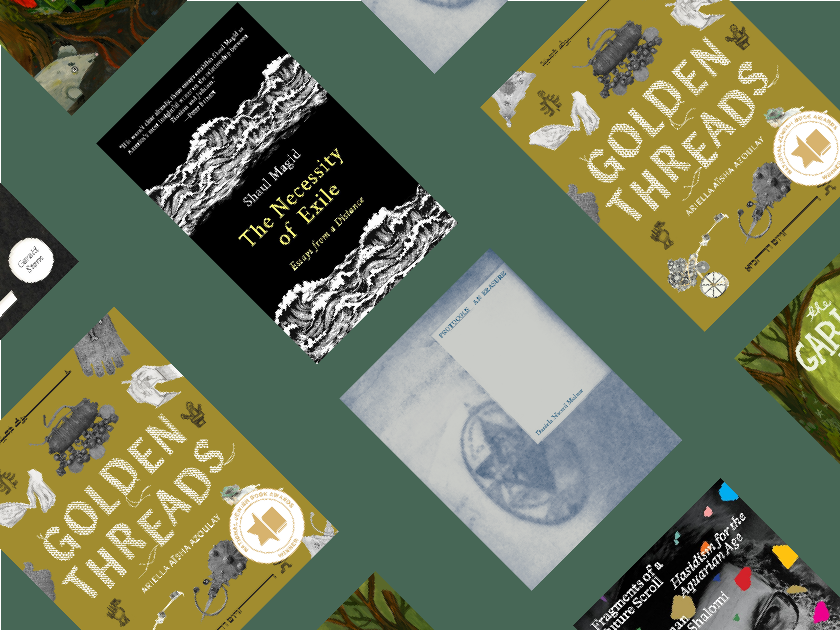
What’s the scoop on publishing? What Jewish books are agents, editors, and publishers especially excited for us to read? JBC’s series BookWatch is here to answer these frequently asked questions. In each installment, a publishing insider writes an email to introduce themselves, give us a behind-the-scenes look at their work, and tell us about forthcoming Jewish books they can’t wait to usher into the world. This month, we’re featuring Eden Pearlstein, cofounder and editorial director of Ayin Press.
_____
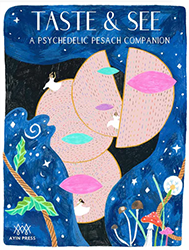
Ayin Press was not started by a fund, an organization, a department, a think tank, or by philanthropic or professional insiders. It was started by two multidisciplinary artists (Tom Haviv and myself) who couldn’t find a home that felt expansive, experimental, interdisciplinary, and Jewish enough for their work or the work they wanted to see more of in the world. Not members of any synagogue, and often on the outside of various arts and organizing spaces, we frequently felt like we had one foot in and one foot out of wherever we were. A core question at the heart of Ayin’s emergence was therefore: Where do people go who don’t completely fit into any one social, spiritual, artistic, or identity box? Or, better yet — where do people go who don’t want to fitinto those boxes?
Our first, clumsy attempt to address this conundrum was to forgo the elevator pitch and take the long steep stairs by creating a poetic manifesto.This went great with funders and foundations! But we felt: Hey, life is messy. People are multidimensional. Why should a press be anything different?
We thus founded Ayin’s curatorial ethos on what we called three pillars: Speculative Theology, Political Imagination, and Radical Aesthetics. In a word — culture. We were interested in all of it, and we rejected the corporate inertia to narrow or simplify our overly ambitious vision or mission. We wanted Ayin Press to be an intersectional place of unlikely juxtaposition, where people from various walks of life and fields of interest, backgrounds, disciplines, and communities might generously bump into each other and discover new things about themselves. That orientation extended to a commitment to both avant-garde and more mainstream work. Why limit ourselves? More specifically, we wanted to support creators and thinkers on the growing edges and help develop and present their work in a dignified way. We feel that the fringes are often where the best ideas are born, and we are committed to cultivating the vital spirit of experimentation and imagination that will hopefully seed new visions for a better future. I mean, how does a prophet screaming in the wilderness make it into a canon anyway?
I know that may all sound highfalutin or whatever. But at the root of it all is making things: making books and other forms of creative work; making meaning; making connections; making friends; making magic. And so, ultimately, we prefer to “show, not tell” what Ayin is all about. In other words, we like to let our books do the talking.
The Power of Culture and Creativity
After initially launching with a gallery show catalog and a digital journal in early 2021, our first three books were expressions of the three curatorial pillars mentioned above: Undertorah by Jill Hammer, a brilliant book of eco-kabbalistic dreamwork; I., the final work by the late, great Gerald Stern — a stunning book-length poem inspired by the prophet Isaiah and a crumbling synagogue on the gentrifying Lower East Side across the street from a Greek diner called The Cosmos (with an introduction by Ross Gay); and The Necessity of Exile by Shaul Magid, a courageous book examining the theo-political concept of exile in the contexts of historical and contemporary Zionism. With these first three books, Ayin’s core template was activated.
Since then, we have continued curating, commissioning, collaborating on, developing, and distributing boundary-pushing work in multiple genres and mediums. Here’s a few examples to give a sense:
Ayin published five books in 2025 (along with twenty-eight digital pieces), and we are proud to share that three of them were nominated for and won awards. SURVIVA: A Future Ancestral Field Guide by Cannupa Hanska Luger, the first publication of Aora, Ayin’s new imprint for general audiences, received PEN America’s PEN/Jean Stein Book Award; Golden Threads by Ariella Aïsha Azoulay received a National Jewish Book Award in the Sephardic Culture category; and Protocols: An Erasure by Daniela Naomi Molnar was named a finalist for a National Jewish Book Award for poetry. And we are just getting started!
The World We Share and Build Together
2026 and the years ahead are looking busy already, with a host of exciting upcoming books, including: the fiftieth-anniversary edition of Reb Zalman Schachter-Shalomi’s first book, Fragments of a Future Scroll, with contributions by Shaul Magid, Tirzah Firestone, Jericho Vincent, and Arthur Kurzweil; Selah: A Báyò Akómoláfé Reader, a collection of poetic short-form writings by one of the world’s leading philosophers; Turn It & Turn It: Post-Secular Essays & Poems by acclaimed Jewish feminist poet and scholar Alicia Ostriker; The Garlic Eaters, a gorgeously illustrated and thought-provoking children’s book about displacement and diaspora by Madison Safer; Speak to the Bones: A Book of Jewish Spells and Incantations by Jericho Vincent and Zvika Krieger; Judaism Is Psychedelic: A Practical Guide by Madison Margolin; the first published selections of Toratah: The Regendered Bible by Yael Kanarek and Tamar Biala; Wherever You Are: Essays Between East and West by Palestinian American poet and aphorist Yahia Lababidi; memoirs from Yuli Novak (the executive director of B’Tselem), Ruth Messinger (the executive director of American Jewish World Service), and Ilana Sumka (the former executive director of Encounter); and the launch of Ayin Audio, our new podcast and audio production department.
In times like these — when conversations outside the algorithmic bubble feel impossible and the inertia of societal fracture begins to feel inevitable — the work of an independent publishing platform is essential. Cultivating imagination, circulating new and important ideas and stories, creating space for different perspectives, and connecting people across ideological abysses through art and literature: these are generative contributions to the health and vitality of the ecosystem. And Jewish culture — as ancient, adaptive, and imaginative as it is — has plenty of tools and techniques to offer us, should we choose to meet this contemporary moment and work toward a future worth living for, together.
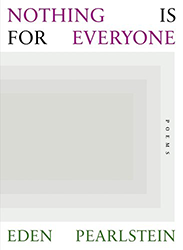
Eden Pearlstein is an interdisciplinary language artist and cofounder/editorial director of Ayin Press. He is the author of Nothing Is for Everyone: Poems, editor of Selah: A Bayo Akomolafe Reader, and creative contributor to SURVIVA: A Future Ancestral Field Guide by Cannupa Hanska Luger. Eden currently lives with his wife and two kids in Philadelphia.