Join a community of readers who are committed to Jewish stories
Sign up for JBC’s Nu Reads, a curated selection of Jewish books delivered straight to your door!
On a rainy autumn evening three years ago, I wandered the streets of Manhattan’s Upper East Side with my ten-month-old son. Pregnant with my second child and with my marriage unraveling, I searched for traces of the old me — not entirely convinced I had ever met her.
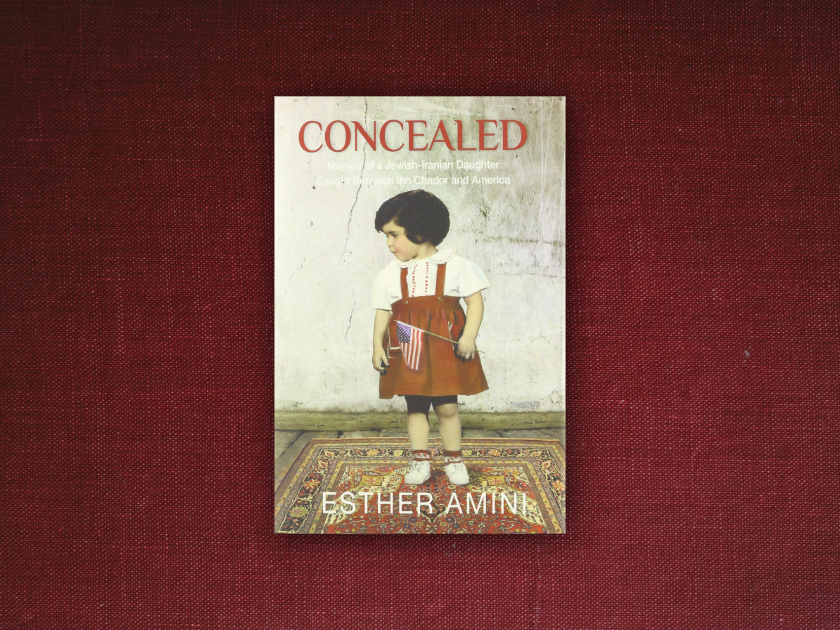
I found myself in front of Logos Bookstore. In the window was a book: Concealed by Esther Amini. The cover showed a little girl holding an American flag. The subtitle read, Memoir of a Jewish-Iranian Daughter Caught Between the Chador and America.
For nearly two decades, I had struggled to write a memoir of my own about a childhood caught between the Soviet Union and Queens, New York.
In 1947, Amini’s family settled in Forest Hills, Queens, after leaving Mashhad, Iran, where generations of Jews had endured forced conversions and persecution. Decades earlier, my paternal great-grandparents, Ahadjan and Yaffa, had fled Mashhad for Merv, in present-day Turkmenistan. I was born there in 1983 and arrived in Queens as an eight-year-old Jewish refugee in 1991.
We shared a name. Esther is my Hebrew name — one I seldom use — given to me by my Mashhadi grandmother, Rachel. After decades of cringing at Americans mispronouncing Radmilla, I had almost forgotten that I was also Esther. Amini writes: “Esther wasn’t just my maternal grandmother’s name, but a name passed on in the Mashhadi community for thousands of years, dating back to Queen Esther.”
We were both daughters of immigrant families, raised — suspended, really — between the freedoms of America and the traditions of worlds that had been hostile to our ancestors, yet that our fathers struggled to leave behind.
Amini’s father was fiercely protective, terrified that American freedoms would corrupt his only daughter. Mine worried about the dangers lurking beyond our front door. “Someone can just throw you in their car, and we will never see or hear from you again,” my dad warned. I had to be home right after school. Dating was forbidden. Shorts and short skirts were outlawed. “Modest! You must buy her modest clothes!” Amini’s father tells her mother in one of the coming-of-age chapters. Modest was one of my father’s favorite words for me, too.
Growing up in Queens, I was shrouded not in a chador but in fear, guilt, and shame. In the chapter “About Face,” Amini writes, “Deep, deep down, I felt I was the delinquent daughter destroying thousands of years of accrued aberu” — the Persian word for honor and reputation. “You cannot bring shame to our family,” my father would warn, starting when I was a scrawny eight-year-old nervously chewing breakfast cereal, trying to understand exactly what he meant. Everything was subject to scrutiny. The way I sat, spoke, dressed, looked, thought. Generations of “accrued aberu” weighed on my body when all I wanted was to be an all-American girl.
Our fathers differed in one important way. Her father discouraged her intellectual ambitions and painted books as evil. “Close your mind!” Books, he felt, poison girls’ minds. My father insisted on education. “Books are your friends!” he’d say when I sobbed that I didn’t have any friends.
Education, though, did not mean independence. In the chapter “Risky Move,” Amini fears for her father’s life when he goes on a hunger strike to protest her leaving for college. Am I killing him? she wonders. My father protested my independence, too. Days after I moved to Manhattan for graduate school at New York University, he returned to Turkmenistan. “Your father can’t handle you living on your own,” my mother explained, as if moving back to an ex-Soviet republic was as normal as taking a walk in the park. Am I killing my father? I wondered, too.
I never imagined that a woman from another generation, with roots in the same Jewish community and raised just blocks away in Queens, could make me feel so seen.
Although our fathers brought their families to America, they continued raising their daughters in the countries they had fled. Back there, as Amini writes, women were “reduced to silence, unable to read or write, unable to leave their stories behind.” Amini’s mother had married at fourteen, her paternal grandmother at nine, both to much older men. My great-grandmothers, Yaffa and Frida, were married at fourteen and thirteen, with Frida marrying a man twenty-eight years her senior. I see my foremothers as powerhouses because they were. After losing their husbands to Bolshevik terror, they had no choice but to become titanium.
After college, Amini’s father arranges her marriage. She agrees, believing that he knows what is best for her. My father tried to arrange mine the summer I graduated from high school. I was seventeen and I refused. “I want to go to college,” I told him. “I want to see the world.”
It took me three years to finish reading Concealed. I would pick it up, read a few chapters, put it down, and return to it months later. During that time, I gave birth to my second son, filed for divorce, and crossed the river back to Queens, moving in with my parents with my children, both under two years old. Through it all, the book with the little girl holding an American flag was never far away.
In a later chapter, when Amini decides to get a divorce, her father tells her that it would be a disgrace to their family. Americans divorce. Iranians don’t divorce. I suspected my father felt the same. Yet the man whose disapproving looks I had spent my childhood dodging welcomed my children and me home.
“Can we ever really know our parents?” Amini wonders before answering, “We can only try.”
Growing up, I rarely heard women in my community speak openly about the things Amini writes about. For years, I felt alone in my story, filling notebooks and storing my writing in drawers or on dusty hard drives. I never imagined that a woman from another generation, with roots in the same Jewish community and raised just blocks away in Queens, could make me feel so seen.
Thinking of the women who came before her, Amini writes that she “must tell their story and mine.” In writing Concealed, she gave them a voice.
And somewhere in her pages, I met the girl I’d been looking for. The one who arrived in Queens, more than once, with a name she had almost forgotten.
Radmilla Suleymanova is a New York-based writer and journalist who serves as a Press Officer at the United Nations. Previously, she was a Senior Business and Economics Producer for Al Jazeera English. Her writing has appeared in the Jewish Telegraphic Agency, The Jerusalem Post and Envoy Magazine. Born in Soviet Central Asia, she came to Queens, New York, as a child refugee. She holds a master’s degree in Global Affairs from New York University.