Join a community of readers who are committed to Jewish stories
Sign up for JBC’s Nu Reads, a curated selection of Jewish books delivered straight to your door!
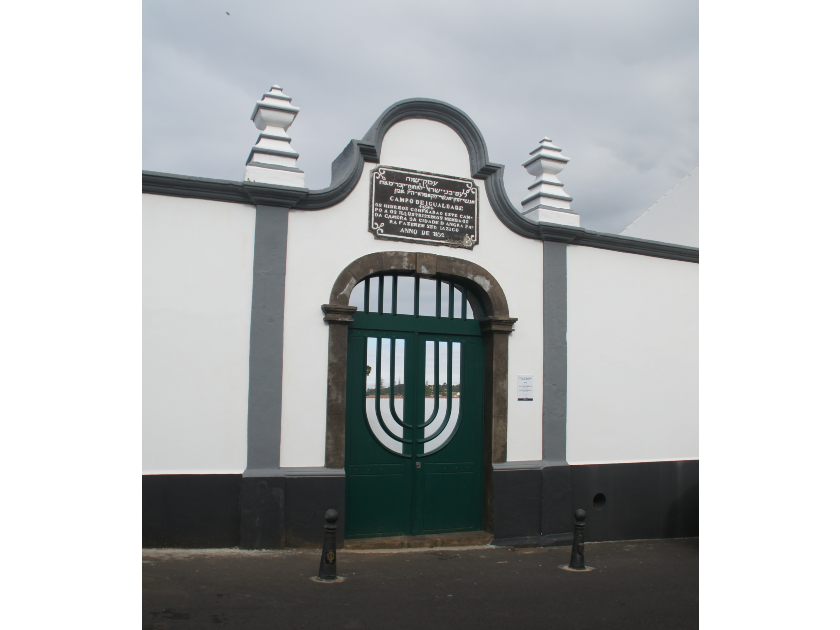
Main gate of the Jewish cemetery of Angra do Heroísmo, Azores, via WikiMedia Commons
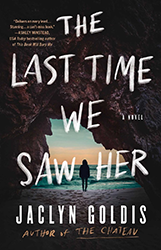
One of my favorite parts of being an author is disappearing into a labyrinth of my own curiosities. And chief among those curiosities has always been setting. A strong sense of place underlies all of my books. Not only do I live abroad, but travel has long been one of my favorite pursuits and an inspiration for my writing. And when I began making space in my creative life for my newest thriller, The Last Time We Saw Her, to reveal itself to me I became transfixed by the Azores. An archipelago located in the Atlantic Ocean midway between the United States and Portugal, these Portuguese islands are exceedingly remote and also, to my surprise, once home to an exceptionally small — fewer than three hundred at its heyday — Jewish community.
The story of the Jews of the Azores islands is little known and seldom told. Several Jewish Portuguese families first settled in the islands in the fifteenth century, fleeing the Inquisition. In the early nineteenth century, more Jews — this time merchants from Morocco, whose families had been expelled from Spain in 1492 — arrived in the Azores. By 1848, the Jews in the Azores numbered 250, with the majority living in Ponta Delgada on Saõ Miguel, where I chose to set the novel. During World War Two, more Jews arrived in the Azores to escape Nazi persecution. But after the war, the Ashkenazim who had found refuge in the Azores dispersed, and the native Sephardic population dwindled due to emigration, death, and intermarriage. There are currently few, if any, Jewish descendants of the original Jewish Azoreans living on the archipelago.
The Azores were remote enough that the Inquisition’s reach was attenuated, but not so remote that it didn’t reach it altogether. Many Portuguese Jews became anusim, a Hebrew term found in Halakha connoting that they were forced to convert. In fact, a 2004 genetic study found that 13.4% of the Y chromosomes of Azoreans is Jewish, compared to just 6.8% of mainland Portugal. To this day, distinctly Jewish rituals remain woven into the lives of Portuguese Catholics, though they are often unaware of the rituals’ origins in their anusim ancestors. Such rituals include candle lighting ceremonies on Friday nights, various death rituals, and a diet with echoes of kosher practices.
One of the most surprising revelations of hidden Jewish life on the Azores came in 1997 when a group of schoolchildren stumbled across Torahs in a cave on Saõ Miguel. The cave, also said to contain Yiddish writing on its walls, is believed to have been used by Jews on the island to conceal their faith.
I typically conduct significant research for my books, especially when I weave in factual history; I’ve done this for my thrillers set in Provence, Italy, the former Soviet Union, and South Africa. However, due to the small Jewish Azorean community and the fact that so many had assimilated over the years, it was difficult to pin down written accounts or knowledgeable sources. But I did manage to speak with a few individuals who were either descendants of Jews of the Azores or in-the-know islanders. One woman told me how her ancestors would practice their Judaism in secret, even when it was prohibited. They had drawers in their dining-room tables and when visitors arrived as they were eating, they would hide their kosher food in those drawers to avoid being discovered.
One of the most surprising revelations of hidden Jewish life on the Azores came in 1997 when a group of schoolchildren stumbled across Torahs in a cave on Saõ Miguel.
Moroccan Jews founded the Sahar Hassamain Synagogue in the Azores, the oldest synagogue in Portugal since the Inquisition. It was built to be invisible from the outside, with a façade of a typical Azorean dwelling. When I visited the synagogue on my research trip, I was struck by the plain entrance, in contrast to the lovely, prototypically Sephardic sanctuary with its bimah in the center and wooden pews all around. The synagogue was restored and reopened in 2015 and now functions as a museum and cultural center.
The Jewish merchants who settled in Ponta Delgada from Morocco first imported cloth from Europe, then began exporting oranges and other agricultural products, leading to a sharp improvement in the region’s economy. The Bensaude family — formerly Moroccan Jews — was the most prominent family on the island. When I visited Saõ Miguel, both of my tour guides periodically referred to land the Bensaudes owned and industries they spearheaded. The Bensaudes created banking on the island and even started the now-nationalized Azorean airline. But fearful of Nazi occupation of Portugal, most of the Bensaudes converted during World War Two. The Bensaudes were my loose inspiration for the wealthy da Costa family in The Last Time We Saw Her.
The true history of the Jews of the Azores provided me with a fascinating foundation to imbue into the otherwise fictional nefarious shenanigans of my modern-day thriller. As a Jewish author, I am endlessly fascinated by the question of how we navigate the world when the past is always in the room with us. On its surface, my latest thriller involves a long-ago disappearance tied to a legend of missing treasure. We follow along as a group of twenty-somethings, who are all unreliable narrators, reflect on the pivotal trip they took to explore their Jewish heritage the summer they were seventeen and the profound repercussions it had. Beneath the simmering suspense and journey of discovery, though, is a deeply Jewish question of what pieces of ourselves do we conceal in order to survive.
This is also the first time I’ve centered a Sephardic story in my fiction. My earlier books — and much of Western literature about Jewish life — explores Jewish identity mostly through Ashkenazi perspectives. But in The Last Time We Saw Her, the characters’ Sephardic identity quietly shapes their sense of belonging and obligation. Sephardic experiences carry their own distinct texture of exile and resilience, and I wanted to explore that in these pages.
As a teenager, I joined March of the Living and United Synagogue Youth trips to Poland, Israel, and London to explore my own heritage, and I went to sleepaway camps — including one formative summer in the western United States spent hiking and camping in tents each night. Those experiences became formative parts of building my Jewish identity and the heritage trip centered in this book is a sort of combination of all those experiences.
We are living at a time when concealing our Jewishness has once again become a question on our minds — wondering if it is safe to wear our Stars of David or chai necklaces, or to speak Hebrew in public. And yet what I keep learning as a Jewish author is that every time we tell and read Jewish stories, we refuse erasure, preserve memories, and celebrate our culture and traditions.