Join a community of readers who are committed to Jewish stories
Sign up for JBC’s Nu Reads, a curated selection of Jewish books delivered straight to your door!
This year we are celebrating 101 years of Jewish Book Month! Begun in 1925 by trailblazing Boston librarian Fanny Goldstein, this year’s celebration is held from November 3rd to December 3rd (the month before Hanukkah). During the past century, Jewish Book Month has been commemorated with bustling book festivals, eye-catching table displays, author events, read-a-thons, and more. Each year, we mark the occasion by working with a designer to create a unique and thoughtful poster to mark the occasion. We were thrilled to speak with this year’s poster designer, Bentzion Goldman, about his approach to creating this year’s stunning poster. (You can see posters from years past here!)

Simona Zaretsky: Could you speak about the creative process for designing this poster?
Bentzion Goldman: The idea for this year’s poster came from a conversation with the Jewish Book Council team about how books enable conversation about Jewish life and foster connections between readers and foster connections between readers and the Jewish community. We wanted to visualize this idea of connection through books, and create an artwork that represented the breadth and diversity of Jewish literature.
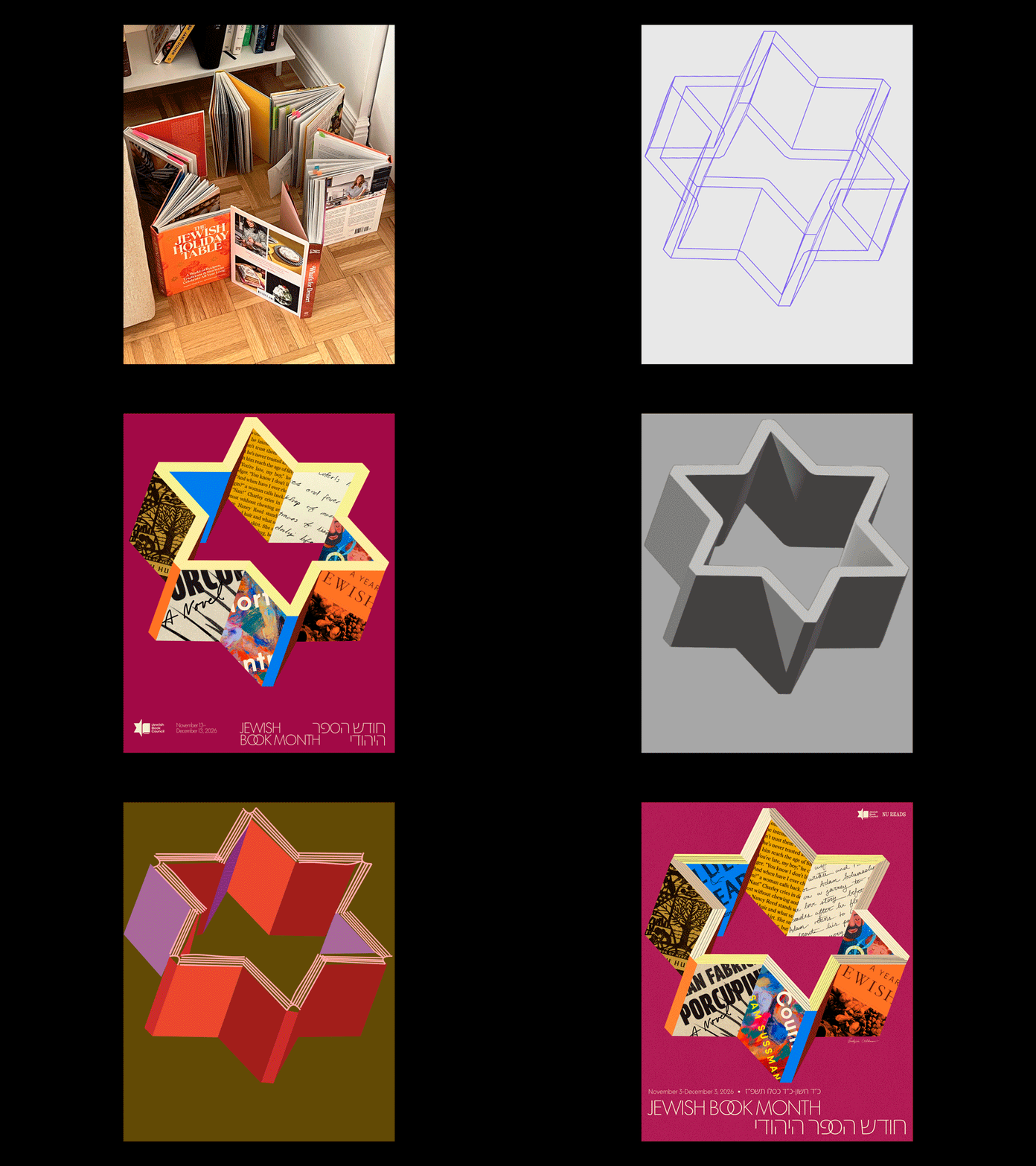
The idea for the illustration itself was derived from JBC’s logo which is made up of half a book and half a Star of David. I loved the simplicity of using interlocking books to create a Star of David and how it could literally represent the idea of connection through books.
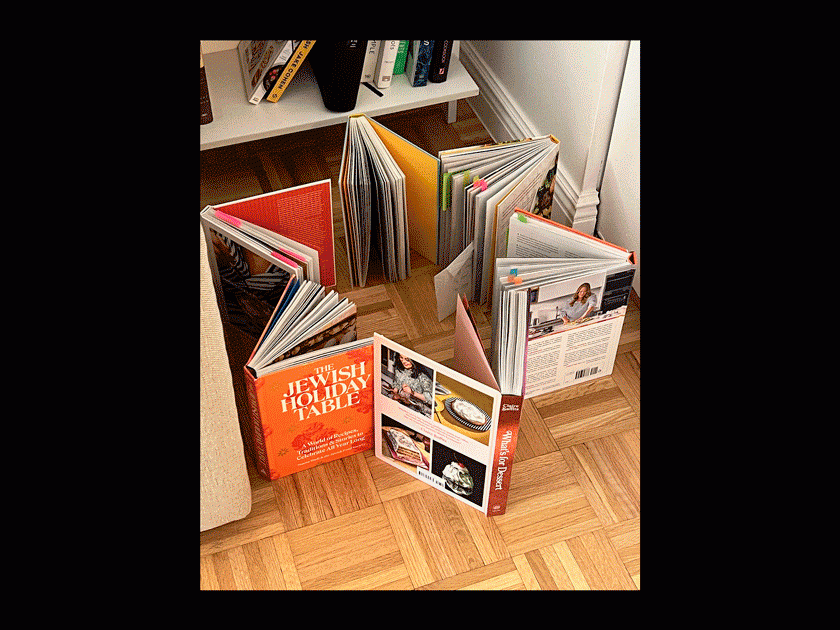
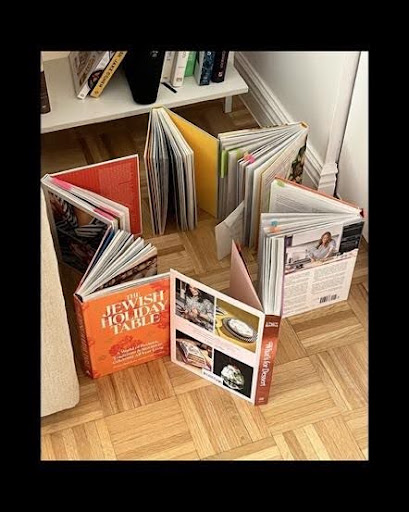
To actually figure out the structure of the illustration itself, I started on the floor of my apartment, arranging books from my bookshelf in the shape of a Star of David and photographing them from various angles on my phone. This helped me work out the arrangement that would work best and it was also a refreshingly hands-on way to start the creative process. I then digitally created a 3D shape that I could move around to get the angle exactly right.
All images courtesy of Bentzion Goldman
SZ: Could you walk us through the books you chose to include in the poster?
BG: As I mentioned, the goal was to represent the diversity of literature that JBC uplifts. Our selections were intended to cover various genres, ages, and formats. We selected cookbooks, novels, works of nonfiction, and children’s books. Using a collage technique enabled us to show vignettes of these selections, through image and text.
The poster includes the cover of Boy from the North Country by Sam Sussman, a National Book Award finalist and Nu Reads selection; a handwritten summary of Delicate by Ron Segal, a Nu Reads exclusive; and an excerpt from Fagin the Thief by Allison Epstein, a National Jewish Book Award winner.
Other selections include the cookbook A Year of Jewish Joy by Rebekah Lowin; the illustrated children’s book The Remembering Candle by Alison Goldberg, illustrated by Selina Alko, a National Jewish Book Award winner; and the covers of As a Jew by Sarah Hurwitz, a National Jewish Book Award winner, and Porcupines by Fran Fabriczki, a Nu Reads selection.
SZ: What is your relationship with Jewish storytelling?
I come from a family of avid readers and I’ve always loved stories that explore Jewish themes, in particular ones that weave artistic expression into them. My favorite books have always been those that combine writing and art in new and unexpected ways. As a kid, I remember loving David Wisniewski’s Golem, with its dramatic papercut illustrations. Even now, I’m endlessly inspired by books that use to art to offer a new take on familiar themes such as Jessica Tamar Deutsch’s The Illustrated Pirkei Avot, which takes the form of a graphic novel, and the The Seder Oneg Shabbos Bentsher which combines the text of the birkon with historical open-sourced illustrations and inclusive texts for a unique and delightful take on a centuries old format.
SZ: Does literature influence your work? And if so, what books or authors?
BG: Literature absolutely influences my work. And as a New Yorker with a long subway commute, I always have something to read in my bag. This past year, I published a Jewish food calendar featuring photographic reinterpretations of Jewish cuisine. As part of the research process, I read Claudia Roden’s meticulous The Book of Jewish Food as well as Jewish Food Society’s The Jewish Holiday Table. I also read many regional Jewish cookbooks to learn as much as possible about less familiar Jewish dishes and traditions.
One of my most prized possessions is Ellen Frankel’s The Encyclopedia of Jewish Symbols; I find myself reaching for this book at the beginning of any Jewish-related project. While I read a large amount of nonfiction, fiction influences my work too albeit in less direct ways. Reading, at its core, allows you to think beyond your expectations and examine ideas in new ways. The design process is very much like this too — in that way they are both parallel creative acts.
SZ: What artists inspire you?
BG: Ben Shahn is one of my all-time favorites, particularly his drawings and also his Hebrew lettering which I think about at least once a month. For this project with JBC, I thought of Yaacov Agam and Elaine Lustig Cohen, two Jewish artists who embraced geometry, abstraction, and bold use of color. In my design, I strove to achieve a balance between literal representation and geometric abstraction.
Simona is the Jewish Book Council’s manager of digital content strategy. She graduated from Sarah Lawrence College with a concentration in English and History and studied abroad in India and England. Prior to the JBC she worked at Oxford University Press. Her writing has been featured in Lilith, The Normal School, Digging through the Fat, and other publications. She holds an MFA in fiction from The New School.